Two weeks ago I perused the shelves of a used book store looking for a birthday gift for my brother. In the course of my searching, my eyes lit upon a copy of Ernest Hemingway's The Old Man and the Sea (1952). I flashed back to a dinner out on the occasion of my wedding, at which my dad rehearsed a long piece from a literary work which included--as I remembered it--an old fisherman dying in his boat. Caught up by the memory, I purchased Hemingway's short story then and there.
The "About the Author" paragraph at the end of the book declares Hemingway to be "one of the most important influences on the development of the short story and the novel in American fiction" (Scribner Paperback Fiction edition). Having failed to read any Hemingway before this book, I cannot tell you why his work is described this way. I can tell you that after the first three pages I had to read it to the end.
The Old Man and the Sea breaks all the rules of writing. It has commas galore in the wrong places. Many sentences run on while others are only fragments. It does not honor the traditions of marking by punctuation what text is narration and what is the personal thought of a character. And the whole book reads like a staccato viola piece, temptuously and tortuously choppy. Like the waves of a windy sea. Perhaps this union of form and function help to make it the masterpiece that it is.
Two characters, an old man and a boy, have active roles in the story, and in ninety-four out of the book's one hundred twenty-seven pages we only read about the old man. Yet the old man's determination, his depth of experience, and his sympathy for the sea held my attention better than the kaleidoscope of characters in, say, The Brothers Karamozov. Perhaps the most masterful work within the narrative is the blurring of the line between human and oceanic, sea and sky, heaven and world, which comes to be embodied in the old man as he enters the deadly struggle with the biggest fish ever caught. Hemingway narration keeps us on the line, wondering equally whether fisher or fished will win and whether we will find ourselves in the man or the sea.
Like the artist who suggests meaning by depicting voids, The Old Man and the Sea never offers concrete statements of theme, purpose, or moral. And in this case the story is more powerful for the darkened void, like the attractive mystery of a sea unfathomed. One could find almost any enduring theme within the narrative, if one but reads the story another time. (And I have done so, twice now.)
The "About the Author" text mentions that Hemingway, recipient of both the Pulitzer Prize and the Nobel Prize for Literature, killed himself in 1961. Knowing nothing about his life outside this book's one-page synopsis, I find there a great mystery. Though I agree with the rear cover which lauds The Old Man and the Sea as heralding "the classic theme of courage in the face of defeat, of personal triumph won from loss," I hear in the story a sad twist at the end which betrays both courage and triumph. Like so much of the book, the twist is not clear and sharp but deep and murky. Yet it ends the great minuet of The Old Man and the Sea on a chord that does not resolve, which, I suspect, also characterizes the lives of those who end their own.
I am left to wonder, both of the old man and of Hemingway himself: can one conquer the sea, or only weather its storms?
After my first read of the short story, I realized that the piece my dad recited was not Hemingway at all, but Coleridge's The Rime of the Ancient Mariner. When I bought this book, I was trolling in the wrong waters. But to my joy, I have caught a big fish after all.
Thanks to Annie's Book Stop in Manchester, New Hampshire for putting some classics right up front.
~ emrys

Friday, January 13, 2012
Wednesday, January 04, 2012
Savoring the Spirit
I love black preaching. White preaching (classical preaching, Presbyterian preaching), of which tradition I am a part, relies upon uniform control of concepts and words as the primary vehicle of the Spirit. Most of the time, calmness and crisp diction are the hallmarks of good sermon delivery. The goal is to blossom a flower for the contemplation of the congregation's mind.
Not so black preaching. My observation of black preaching is that it seeks to drive truth into the congregational bones. And the primary vehicle of the Spirit is the response of those bones. Do those bones stand up in response to the preaching? Do those mouths open to praise the Lord? Does the congregation respond to the call of the Word? Does real, embodied life show up when the Word is unleashed?
These three days I am steeping in the blessing of twenty-six sermons delivered by young preachers. I'm staying at a hotel in Louisville, Kentucky and attending the Festival of Young Preachers. One hundred twenty-five young preachers (between the ages of 15 and 29) preach in five different rooms over the course of eleven sessions. Though all preachers are starting with Jesus' "sermon on the mount" (Matthew 5-7), every sermon is unique because every preacher is unique. I have been laughing with young Orthodox preachers. I have thrilled at teenage young women announcing the gospel in the context of Advanced Placement exams. I have wept as I responded "Amen!" to young black preachers. I've been basking in the glory of the Spirit moving in strange, loud, soft, and wonderful ways among the next generation of preachers.
I have the joy and responsibility of bringing the Word to a congregation most Sundays of every year. I rarely get to sit back and soak in someone else's delivery. And even when I do, it's most often within the cool intellectual climate of Presbyterian worship. Hearing such a variety of interpretations of scripture both from folks who craft elegant turns of phrase, and also from folks who repeat a three-word litany to make a drum-beating summons, is a treat for my soul.
What a cool opportunity, too, to bring a young man from our congregation to be part of this homiletic extravaganza. I have high hopes that he will go home remembering how rich, varied, and eccentric are the ways in which the Spirit words in the work of the Word.
If you're involved in the work of preaching to the world; if you're interested in the elevation of young preachers for the next generation of the Church; if you're young and want to preach; or if you would just jump at the chance to bask in the joy of hearing young energy in the pulpit, you must check out the opportunities at the Academy of Preachers. The Lord is doing some cool stuff here.
~ emrys
Not so black preaching. My observation of black preaching is that it seeks to drive truth into the congregational bones. And the primary vehicle of the Spirit is the response of those bones. Do those bones stand up in response to the preaching? Do those mouths open to praise the Lord? Does the congregation respond to the call of the Word? Does real, embodied life show up when the Word is unleashed?
These three days I am steeping in the blessing of twenty-six sermons delivered by young preachers. I'm staying at a hotel in Louisville, Kentucky and attending the Festival of Young Preachers. One hundred twenty-five young preachers (between the ages of 15 and 29) preach in five different rooms over the course of eleven sessions. Though all preachers are starting with Jesus' "sermon on the mount" (Matthew 5-7), every sermon is unique because every preacher is unique. I have been laughing with young Orthodox preachers. I have thrilled at teenage young women announcing the gospel in the context of Advanced Placement exams. I have wept as I responded "Amen!" to young black preachers. I've been basking in the glory of the Spirit moving in strange, loud, soft, and wonderful ways among the next generation of preachers.
I have the joy and responsibility of bringing the Word to a congregation most Sundays of every year. I rarely get to sit back and soak in someone else's delivery. And even when I do, it's most often within the cool intellectual climate of Presbyterian worship. Hearing such a variety of interpretations of scripture both from folks who craft elegant turns of phrase, and also from folks who repeat a three-word litany to make a drum-beating summons, is a treat for my soul.
What a cool opportunity, too, to bring a young man from our congregation to be part of this homiletic extravaganza. I have high hopes that he will go home remembering how rich, varied, and eccentric are the ways in which the Spirit words in the work of the Word.
If you're involved in the work of preaching to the world; if you're interested in the elevation of young preachers for the next generation of the Church; if you're young and want to preach; or if you would just jump at the chance to bask in the joy of hearing young energy in the pulpit, you must check out the opportunities at the Academy of Preachers. The Lord is doing some cool stuff here.
~ emrys
Sunday, January 01, 2012
Carbon Sasquatch
After a conference in Louisville, Kentucky next week, I'll be flying from there to Manchester, New Hampshire. Via Orlando, Florida.
Thank you, Southwest Airlines, for filling my annual carbon footprint for 2012 before Epiphany.
~ emrys
Thank you, Southwest Airlines, for filling my annual carbon footprint for 2012 before Epiphany.
~ emrys
Wednesday, December 28, 2011
Going Digital
It's official. As in a Mirror, my (first) fantasy fiction novel, is now available in Kindle (.mobi) and other e-reader (.epub) formats. See the link on the right side of this blog page to get your copy.

Thanks to Sara for setting up the PayPal link.
Happy e-reading!
~ emrys
Thursday, December 22, 2011
Tin Years
As soon as last year's anniversary was over, I looked to see what the material was for the ten-year anniversary. Tin. Tin? Other than being a poetic pun on "ten," I couldn't see why tin made an attractive material for gifts. I certainly didn't understand why it came after bronze. But in the spirit of this discipline, I obeyed the list and racked my brain to think of something I could make out of tin that would be useful for Sara.
And I came up with nothing. Less than what I dreamed up for bronze.
I discovered that I possessed something made out of tin (a large popcorn tin, in fact), but had no idea what to make.
After discarding all sorts of completely useless ideas, I settled on the prospect of wrapping something otherwise useful in tin. Since ten years has a benchmark quality about it, in our decimal society, I decided to make a photo collage and set it in a shadowbox frame wrapped in tin.
 One cheapo shadowbox frame and an hour later, I had a system down for cutting, bending, and wrapping the tin around the wood.
 The edges of tin pieces are sharp. I think I spilled more blood making this gift than the last nine put together. I hope Sara appreciates this--if she doesn't appreciate the quality of the craftsmanship.


 I beat the surface of the tin, both to hide my unintentional scratches and to reflect a momentary thought that after ten years any relationship, though it may shine, will also have its fair share of dents and divots.

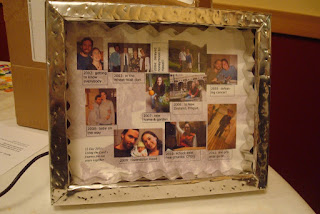 This, I think, is the strangest one of my anniversary gift series. Fitting perhaps, though, as it seems strange to reflect on ten years of married life. As I imagined what photos I would want to include, I struggled to remember what major events happened in 2003, 2004, and 2007--to name a few. Funny how time collapses certain spans flat while preserving some signature moments.
I wonder what it will be like at twenty years.
~ emrys
And I came up with nothing. Less than what I dreamed up for bronze.
I discovered that I possessed something made out of tin (a large popcorn tin, in fact), but had no idea what to make.
After discarding all sorts of completely useless ideas, I settled on the prospect of wrapping something otherwise useful in tin. Since ten years has a benchmark quality about it, in our decimal society, I decided to make a photo collage and set it in a shadowbox frame wrapped in tin.


Every one of these annual projects has a kindergarten feel to it. I sometimes feel as if I'm putting myself back in kindergarten, doing art projects that the parents will coo over because they're obliged to do so. Then three years later, when the next clay paperweight comes home from school, the old one will become a garden ornament or fodder for the trash truck. But it's the thought that counts, right?


Last but not least, the collage of ten representative photos, one from each year together.

I wonder what it will be like at twenty years.
~ emrys
Merry Christmas!
 \
\
Dear Friends and Family:
Merry Christmas! We hope that you are able to fully appreciate the joy and wonder of this season. If you need a little help, take a 2-(almost 3)-year-old out to look at Christmas lights!
Gwendolyn is everything you would expect from an active two year old. She will very proudly tell you that she’s “Two and a haff be tree” (translation: “I’m 2 1/2 and will be 3”) since she’s recently figured out she has a birthday coming up! Christmas trees and lights are a thing of wonder and so much fun to enjoy with her!
2011 was fast and full. Highlights this year include Emrys’ 5 year anniversary at Nineveh Presbyterian Church, Sara’s 6 years of remission and our 10th wedding anniversary. We are also celebrating the new little one that will be joining our family in June 2012. Our area was hit with record-breaking flooding in September, and amidst the devastation it was amazing to watch a local community, and a larger faith community, come together to help out.
Our lives are full, we are blessed, and the guest bed’s made up—we’d love to have you visit!
Love, Emrys, Sara & Gwendolyn
P.S. Our home phone number will be changing on January 1st so if you need the new number, please email us.
Sunday, December 11, 2011
Unlikely Bedfellows
Growing up I used to watch a lot of Tom & Jerry cartoons. The implicit violence was both extreme and cartoonish: both characters fared poorly, then always came back in full health for the next episode.
Angels and demons made a frequent appearance in the show. Tom or Jerry, when faced with a decision about whether to maim, cripple, or torture his nemesis, would have a haloed figure dressed in white appear on one shoulder, bending toward mercy. On the other shoulder would appear a horned red figure, whispering cruelty into the other ear.
What a genius way to depict the struggle of conscience! Where did these guys come up with this stuff?
I just discovered that the twin angels (lofty and fallen) of Tom & Jerry have existed for at least six hundred years. As I read through Book I, Chapter XIV, section 7 of John Calvin's Institutes of the Christian Religion (ed. McNeill, trans. Battles), I found this nugget, during Calvin's discussion of guardian angels:
" . . . the common folk imagine two angels, good and bad--as it were different geniuses--attached to each person."
Calvin remains noncommittal on whether persons have their own guardian angels. But I'm sure he'd be happy to know that the commoners' speculation about them brought entertainment to so many children of my generation.
~ emrys
Angels and demons made a frequent appearance in the show. Tom or Jerry, when faced with a decision about whether to maim, cripple, or torture his nemesis, would have a haloed figure dressed in white appear on one shoulder, bending toward mercy. On the other shoulder would appear a horned red figure, whispering cruelty into the other ear.
What a genius way to depict the struggle of conscience! Where did these guys come up with this stuff?
I just discovered that the twin angels (lofty and fallen) of Tom & Jerry have existed for at least six hundred years. As I read through Book I, Chapter XIV, section 7 of John Calvin's Institutes of the Christian Religion (ed. McNeill, trans. Battles), I found this nugget, during Calvin's discussion of guardian angels:
" . . . the common folk imagine two angels, good and bad--as it were different geniuses--attached to each person."
Calvin remains noncommittal on whether persons have their own guardian angels. But I'm sure he'd be happy to know that the commoners' speculation about them brought entertainment to so many children of my generation.
~ emrys
Monday, December 05, 2011
Much Ado About . . .
concrete.
The addition to our first floor, completed in August, brought about eighty new square feet to our kitchen, making it a real potential "eat-in" kitchen (which it was billed when we bought it, but never actually could serve that way). As a result, however, most of our kitchen is sea-foam green tile, with eighty square feet of unfinished concrete pad.
And the concrete pad is not level.
We have dreams of installing hardwood laminate (bamboo, to be specific), and are nearing our savings goal to pay for the stuff. Before it can be installed, however, the "new" section of floor needs to be level. To ascertain just what might be needed, I conscripted my HandyGirl to do some assessment (note sunglasses to protect eyes from concrete chips I was chiseling):

With a one-and-one-quarter-inch drop over forty-eight inches, the length of the new kitchen area would require a significant volume of concrete. I have worked with just enough concrete to know that screeting and troweling are not my thing--especially in confined spaces. So I spent a lot of time comparing "self-levelling" concrete. Several suppliers make it, but it turns out that no weekend warrior homeowner buys the stuff, because the DYI retailers don't carry it. (This should have tipped me off early; but it didn't.) So I had quite a runaround with the commercial sales departments of Lowe's, Home Depot, and our brilliant local guys to find out how much this part of the job would cost me.
The short ending: $700 to be able to pour a level floor without troweling. Yikes.
About a week before I was to suck it up and take the plunge, I spoke with my brother on the phone. Chris has done a whole lot of random construction and remodeling work on homes. I floated some questions to him about concrete applications. After kindly indulging my plan for a while, he asked, "Why don't you just use wood?"
Huh?
From that conversation, a new plan was hatched which would involve no troweling, no mixing, no warning labels about caustic lime. From leftover wood already in my possession, I am now laying down strips and screwing them to the concrete. Each strip is one-sixteenth of an inch thicker than the one before, gradually raising the finished floor surface to accommodate the concrete's bias.

In case I wondered whether my work would hold up under the soon-to-be-installed new flooring, HandyGirl Quality Control was on the job, testing every run.

It seems that trying to run twenty-two feet along the same two slats is great fun when you're two and a half years old.
Total cost of leveling: $50 for concrete anchors, a big Thank You to Russ for allowing me to borrow his hammer drill, and one home-printed sign for the front door that says "Uneven Pavement"--at least until the new floor is in.
~ emrys
The addition to our first floor, completed in August, brought about eighty new square feet to our kitchen, making it a real potential "eat-in" kitchen (which it was billed when we bought it, but never actually could serve that way). As a result, however, most of our kitchen is sea-foam green tile, with eighty square feet of unfinished concrete pad.
And the concrete pad is not level.
We have dreams of installing hardwood laminate (bamboo, to be specific), and are nearing our savings goal to pay for the stuff. Before it can be installed, however, the "new" section of floor needs to be level. To ascertain just what might be needed, I conscripted my HandyGirl to do some assessment (note sunglasses to protect eyes from concrete chips I was chiseling):

With a one-and-one-quarter-inch drop over forty-eight inches, the length of the new kitchen area would require a significant volume of concrete. I have worked with just enough concrete to know that screeting and troweling are not my thing--especially in confined spaces. So I spent a lot of time comparing "self-levelling" concrete. Several suppliers make it, but it turns out that no weekend warrior homeowner buys the stuff, because the DYI retailers don't carry it. (This should have tipped me off early; but it didn't.) So I had quite a runaround with the commercial sales departments of Lowe's, Home Depot, and our brilliant local guys to find out how much this part of the job would cost me.
The short ending: $700 to be able to pour a level floor without troweling. Yikes.
About a week before I was to suck it up and take the plunge, I spoke with my brother on the phone. Chris has done a whole lot of random construction and remodeling work on homes. I floated some questions to him about concrete applications. After kindly indulging my plan for a while, he asked, "Why don't you just use wood?"
Huh?
From that conversation, a new plan was hatched which would involve no troweling, no mixing, no warning labels about caustic lime. From leftover wood already in my possession, I am now laying down strips and screwing them to the concrete. Each strip is one-sixteenth of an inch thicker than the one before, gradually raising the finished floor surface to accommodate the concrete's bias.

In case I wondered whether my work would hold up under the soon-to-be-installed new flooring, HandyGirl Quality Control was on the job, testing every run.

It seems that trying to run twenty-two feet along the same two slats is great fun when you're two and a half years old.
Total cost of leveling: $50 for concrete anchors, a big Thank You to Russ for allowing me to borrow his hammer drill, and one home-printed sign for the front door that says "Uneven Pavement"--at least until the new floor is in.
~ emrys
Sex and Death Warmed Over
Dracula: The Un-Dead, published in 2009, is the self-proclaimed sequel to Bram Stoker's original Victorian horror story. Bram Stoker's great-grand-nephew Dacre Stoker and "Dracula documentarian" Ian Holt teamed up to co-author the definitive continuation of Bram's classic tale.
Readers seeking to gorge themselves on the Victorian twin taboos of carnal relations and blood-soaked death will not be disappointed. Four of the original characters from Bram's novel reappear, twenty-five years after the Transylvanian Count is defeated--or so we thought--in the Carpathian mountains. The English heroes of the first novel are still alive and kicking; but between alcoholism, depression, and drug addictions, they have been reduced to pale shadows of their former selves. They find themselves--with Quincey Harker, the Hamlet-like non-hero--sucked into more battles with the vampiric realm. This time they fight not only the Count but also a greater demon: the sadistic and sexually weird Countess Bathory.
The deep darkness of the first Dracula, told through the intriguing lens of correspondence written between characters was enough to draw this reader well into this new book. One comes expecting the same horrific battle between terrified good and mysterious evil; the greatest fear in Bram's telling grows from one's not knowing how vast and formless is the shadow of the vampire. The Un-Dead, however, surrenders the sharpest weapon of the horror story by revealing too much. The narration attempts to inform the reader about too much of the inner lives of the characters, rather than allowing the mind of the reader--which is often darker than any author's pen--to infer from the action. In writer's club parlance, The Un-Dead "tells when it should just show." The revelations are so numerous, varied, and at times long, that the reader gets distracted from the movement of the plot, which would otherwise keep readers turning the pages late into the night.
(Full disclosure: this reviewer admits that these faults often arise in the work of freshmen novelists, of which he is one.)
Perhaps the overindulgence of words stems from the intent of the authors, as described in an extended authors' note at the end of the book. The young Stoker and Holt composed this piece in order to "reclaim Dracula" from its use by so many other authors and screenwriters in the last hundred years. At the same time, Stoker and Holt sought not to alienate the Dracula fans who have come to the realm through the other (admittedly bastardized) versions of the Count's story. As a result, the thick blood of Vlad the Impaler gets diluted in The Un-Dead until the dreaded nemesis of Bram's novel seems a hobbling hodge-podge of motivations, desires, and choices. The authors' goal of exhaustive historical accuracy does not rescue the book, as descriptions of people and places often come across as professorial name-dropping that should have been left on the cutting room floor.
The real bite of a horror story like Dracula, un-dead or otherwise, is the power of a simple narrative simply told. The insight of the great Aristotle is as instructive here as it was thousands of years ago: a story has a beginning, middle, and end. In a horror story, those parts ought to be just long enough to inflict the wound of fear. Then the story vanishes in the night, leaving the reader with an insatiable desire for more. In its attempt to reclaim the name of Dracula for the Stoker family, The Un-Dead may well have put the nail in the coffin of other would-be heirs. And Dracula-geeks will likely find saliva dripping from the fangs at all the insider information buried in the text. As frightening tale destined to become a classic, however, The Un-Dead is too anemic to bring Bram's popular legacy back from the grave again.
~ emrys
Readers seeking to gorge themselves on the Victorian twin taboos of carnal relations and blood-soaked death will not be disappointed. Four of the original characters from Bram's novel reappear, twenty-five years after the Transylvanian Count is defeated--or so we thought--in the Carpathian mountains. The English heroes of the first novel are still alive and kicking; but between alcoholism, depression, and drug addictions, they have been reduced to pale shadows of their former selves. They find themselves--with Quincey Harker, the Hamlet-like non-hero--sucked into more battles with the vampiric realm. This time they fight not only the Count but also a greater demon: the sadistic and sexually weird Countess Bathory.
The deep darkness of the first Dracula, told through the intriguing lens of correspondence written between characters was enough to draw this reader well into this new book. One comes expecting the same horrific battle between terrified good and mysterious evil; the greatest fear in Bram's telling grows from one's not knowing how vast and formless is the shadow of the vampire. The Un-Dead, however, surrenders the sharpest weapon of the horror story by revealing too much. The narration attempts to inform the reader about too much of the inner lives of the characters, rather than allowing the mind of the reader--which is often darker than any author's pen--to infer from the action. In writer's club parlance, The Un-Dead "tells when it should just show." The revelations are so numerous, varied, and at times long, that the reader gets distracted from the movement of the plot, which would otherwise keep readers turning the pages late into the night.
(Full disclosure: this reviewer admits that these faults often arise in the work of freshmen novelists, of which he is one.)
Perhaps the overindulgence of words stems from the intent of the authors, as described in an extended authors' note at the end of the book. The young Stoker and Holt composed this piece in order to "reclaim Dracula" from its use by so many other authors and screenwriters in the last hundred years. At the same time, Stoker and Holt sought not to alienate the Dracula fans who have come to the realm through the other (admittedly bastardized) versions of the Count's story. As a result, the thick blood of Vlad the Impaler gets diluted in The Un-Dead until the dreaded nemesis of Bram's novel seems a hobbling hodge-podge of motivations, desires, and choices. The authors' goal of exhaustive historical accuracy does not rescue the book, as descriptions of people and places often come across as professorial name-dropping that should have been left on the cutting room floor.
The real bite of a horror story like Dracula, un-dead or otherwise, is the power of a simple narrative simply told. The insight of the great Aristotle is as instructive here as it was thousands of years ago: a story has a beginning, middle, and end. In a horror story, those parts ought to be just long enough to inflict the wound of fear. Then the story vanishes in the night, leaving the reader with an insatiable desire for more. In its attempt to reclaim the name of Dracula for the Stoker family, The Un-Dead may well have put the nail in the coffin of other would-be heirs. And Dracula-geeks will likely find saliva dripping from the fangs at all the insider information buried in the text. As frightening tale destined to become a classic, however, The Un-Dead is too anemic to bring Bram's popular legacy back from the grave again.
~ emrys
Thursday, December 01, 2011
Dark and Deep
Any book with a series head "Studies in Dogmatics" ought to fill the reader with trepidation. Not so this reader, who dove into Holy Scripture by G. C. Berkouwer like a freshie into the Loch Ness. Much like the waters of that ancient lake, the text of Berkouwer's work (translated from Dutch by Jack B. Rogers, 1975) proves to be deep, dark, and cold.
But even the dream of tackling a textbook plumbing the mysterious--even murky--depths of such a subject as "holy scripture" must fill the reader with awe. After all, the relationship of holy scripture to faith, ethics, the Church, and the Holy Spirit presents such a tangled web of ovular logic and philosophical crenelations; I would accept the challenge to write a textbook on the Trinity instead. Yet Berkouwer took up the pen to follow each thread in the Gordian knot of holy scripture, the essential and overflowing witness upon which so much of the life of the Church depends. For such courage, at very least, Berkouwer's work ought to be praised.
Holy Scripture possesses a density of thought and logic which forces the reader's mind either to slide over large pieces of thought or to creep slowly through each piece of terrain. A fifteen-hundred page work might have brought his readers to the same heights of erudition and wisdom; instead Berkouwer (edited slightly by Rogers) makes us scale the sheer wall of nearly four hundred pages to reach the crown. Reading this work is work. With almost non-existent use of metaphor or illustrative narrative, Holy Scripture calls for a constant upward climb toward complete analysis of the subject at hand. When logical purity requires the use of numerous negatives rather than the blanket assertion of a positive, Berkouwer does not shy away, but demands that the reader's mind follow the circuitous route to the precise goal of understanding.
For all the challenge in its reading, however, Holy Scripture delivers the package promised by its table of contents: a comprehensive study of scripture and its relationship to certainty, canon, authority, interpretation, the "God-breathed character," reliability, clarity, sufficiency, and ("But wait! There's more!") preaching and criticism. Like an inchworm plodding its way along every nook and cranny of an oak leaf, Berkouwer leaves no boundary, no contour, no edge unexplored. Holy Scripture is a master work for those in the Protestant and Reformed traditions of Christianity.
Before taking the header "Studies in Dogmatics" to heart, this reader anticipated some new insight into the nature of scripture and its relationship to the Spirit or the Church. I craved some spice which would take the pottage of dogmatical analysis and produce something flavorful and new. About one-third of the way through the book I realized I would not find it here. This conclusion reflects no ill of the text, however, only of the errant assumptions of the reader. Taken for what it is--a grand survey of the intersection of the bible with all these different topics--Holy Scripture offers a breathtaking view of the landscape. Berkouwer serves as a guide who, from the top of Pike's Peak, can point your telescope to central Iowa and tell you what variety of corn is grown in that farmer's fields. The book reveals several lifetimes' worth of education and reflection on the most important texts the world has ever known. A more solid work on orthodox, Reformed dogmatics no one could desire.
After the climb has brought us to the summit, however, we are still unable to gaze through the rock on which we stand. At the center of scripture is a mystery rather than a logical syllogism. In Berkouwer's words, "the unique authority [of holy scripture] can only be acknowledged and experienced on the way; it is not acknowledged on the grounds of a preceding consideration, and the way then followed as a conclusion" (p348). More to the point--and more in keeping with the Reformed tradition of which I find myself a part--scripture is nothing without the Person to whom it points and who speaks through it: the person of Jesus Christ. The faithful struggles of those wrestling with scripture occur within the context of faith in the Spirit of Christ calling us from behind the text. Far from being either a scientific or a magic book in possession of which we might find ourselves, scripture is one vehicle by which we find ourselves in the possession of another--then swimming in a grandiose mystery as dark and deep as life itself. This is the life, the challenge, and the joy of all who follow the Lord Jesus Christ: to live in and through, and to struggle with, holy scripture. Kudos to Holy Scripture for braving the depths of this struggle.
Thanks to my colleague Mark who passed his copy to me.
~ emrys
But even the dream of tackling a textbook plumbing the mysterious--even murky--depths of such a subject as "holy scripture" must fill the reader with awe. After all, the relationship of holy scripture to faith, ethics, the Church, and the Holy Spirit presents such a tangled web of ovular logic and philosophical crenelations; I would accept the challenge to write a textbook on the Trinity instead. Yet Berkouwer took up the pen to follow each thread in the Gordian knot of holy scripture, the essential and overflowing witness upon which so much of the life of the Church depends. For such courage, at very least, Berkouwer's work ought to be praised.
Holy Scripture possesses a density of thought and logic which forces the reader's mind either to slide over large pieces of thought or to creep slowly through each piece of terrain. A fifteen-hundred page work might have brought his readers to the same heights of erudition and wisdom; instead Berkouwer (edited slightly by Rogers) makes us scale the sheer wall of nearly four hundred pages to reach the crown. Reading this work is work. With almost non-existent use of metaphor or illustrative narrative, Holy Scripture calls for a constant upward climb toward complete analysis of the subject at hand. When logical purity requires the use of numerous negatives rather than the blanket assertion of a positive, Berkouwer does not shy away, but demands that the reader's mind follow the circuitous route to the precise goal of understanding.
For all the challenge in its reading, however, Holy Scripture delivers the package promised by its table of contents: a comprehensive study of scripture and its relationship to certainty, canon, authority, interpretation, the "God-breathed character," reliability, clarity, sufficiency, and ("But wait! There's more!") preaching and criticism. Like an inchworm plodding its way along every nook and cranny of an oak leaf, Berkouwer leaves no boundary, no contour, no edge unexplored. Holy Scripture is a master work for those in the Protestant and Reformed traditions of Christianity.
Before taking the header "Studies in Dogmatics" to heart, this reader anticipated some new insight into the nature of scripture and its relationship to the Spirit or the Church. I craved some spice which would take the pottage of dogmatical analysis and produce something flavorful and new. About one-third of the way through the book I realized I would not find it here. This conclusion reflects no ill of the text, however, only of the errant assumptions of the reader. Taken for what it is--a grand survey of the intersection of the bible with all these different topics--Holy Scripture offers a breathtaking view of the landscape. Berkouwer serves as a guide who, from the top of Pike's Peak, can point your telescope to central Iowa and tell you what variety of corn is grown in that farmer's fields. The book reveals several lifetimes' worth of education and reflection on the most important texts the world has ever known. A more solid work on orthodox, Reformed dogmatics no one could desire.
After the climb has brought us to the summit, however, we are still unable to gaze through the rock on which we stand. At the center of scripture is a mystery rather than a logical syllogism. In Berkouwer's words, "the unique authority [of holy scripture] can only be acknowledged and experienced on the way; it is not acknowledged on the grounds of a preceding consideration, and the way then followed as a conclusion" (p348). More to the point--and more in keeping with the Reformed tradition of which I find myself a part--scripture is nothing without the Person to whom it points and who speaks through it: the person of Jesus Christ. The faithful struggles of those wrestling with scripture occur within the context of faith in the Spirit of Christ calling us from behind the text. Far from being either a scientific or a magic book in possession of which we might find ourselves, scripture is one vehicle by which we find ourselves in the possession of another--then swimming in a grandiose mystery as dark and deep as life itself. This is the life, the challenge, and the joy of all who follow the Lord Jesus Christ: to live in and through, and to struggle with, holy scripture. Kudos to Holy Scripture for braving the depths of this struggle.
Thanks to my colleague Mark who passed his copy to me.
~ emrys
Subscribe to:
Posts (Atom)