I enjoy cooking. I love chopping, combining, seeing the finished product and smelling the scents of success, tasting the bounty that comes forth from time spent. It is an art that I enjoy. I love taking a recipe and if baking, following it (almost) exactly to see how it comes out. If it is cooking, tweaking it to how I want it to be. It comes to me with little effort and is fun.
I do not enjoy housekeeping. I do not enjoy scrubbing, cleaning. Don’t get me wrong, I enjoy seeing the house clean, I just don’t like the process of getting it clean. It is work for me. Laundry I don’t mind so much, especially in the summer when I can get outside to hang clothes.
So explains the neglect of the housekeeping chores in my house. I have meals prepared and stocked in the freezer while the spiders set up mansions in the corners of my house. I have vegetables picked and packed away for winter while the dust bunnies continue to grow along the baseboards and under furniture.
After vacation, I decided that I had until the end of the month to get the house clean from top to bottom. It was time to exterminate the dust bunnies and bring in tools of demolition to take out the spider-webs. Last week, I started the Top to Bottom Cleaning List. Today I finished it with a couple exceptions. (My candle workroom is still in progress and waiting for some cabinets as well as the office area where my desk is but I have until the end of the week to meet my deadline.)
Countertops are clear, floors are tidy, things are put away and the dog fur is no longer breeding in the corners. My house is clean and it feels great – now that it’s done. So to celebrate I gave into a craving that’s been hanging around for a few days – chocolate mousse :D.
I’m going to work harder to keep my house clean little by little so I don’t have to spend a whole week cleaning next time!
~sjt

Tuesday, August 26, 2008
Saturday, August 23, 2008
Tomato Tragedy
Experiments are done in order to test hypotheses. That is to say, we want to see if something is true--for instance, "Tomatoes can grow upside-down from hanging buckets and be productive." We might then conduct an experiment. If the tomatoes grew productively, then we would say the experiment was a success. The hypothesis was proven true. If the tomatoes did not grow productively, we would also say the experiment was a success. But we would have discovered that the hypothesis was proven false. (Or at least under these conditions; it's hard to truly prove something false.)
Our upside-down tomato experiment is, in many ways, a true experiment. I was therefore prepared for the tomato plants to grow bushy and grand, but produce no tomatoes. If you've been reading this blog, you know that we have had tomatoes already turning orange. However, I was not prepared for a failure in another realm of the experiment: structural integrity.
This afternoon I walked out into the garden and found this:
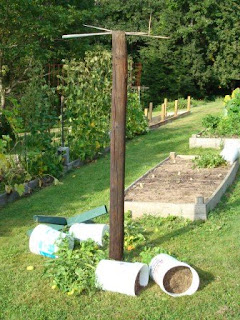 The handle on one of the buckets had failed: pulled out of the plastic that attached it to the side of the bucket. That bucket fell, which loosed the counter-balancing weight from the opposite bucket. The effect of the second bucket pulling on the unbalanced spar tore the wooden arm apart. Since it was the lower arm, the arm running across it was also dislodged from the post, and down came the remaining two buckets.
Sad day.
What have we learned from this, class? Do not use cheap buckets to hang your tomatoes. Use the free ones that your friend gives you after she's used all the laundry detergent out of them. (Thanks, Margery. You rock.)
Until next year, when I can work out a more sound structure for hanging tomatoes all summer, the four we could salvage (one fell from another post earlier) have been set up thusly:

Now they're Sawhorse Tomatoes. We'll see how they recover from the shock of bungee-jumping without a rope.
It's all about constant improvement. Create, adjust, improve.
~ emrys
Our upside-down tomato experiment is, in many ways, a true experiment. I was therefore prepared for the tomato plants to grow bushy and grand, but produce no tomatoes. If you've been reading this blog, you know that we have had tomatoes already turning orange. However, I was not prepared for a failure in another realm of the experiment: structural integrity.
This afternoon I walked out into the garden and found this:
 The handle on one of the buckets had failed: pulled out of the plastic that attached it to the side of the bucket. That bucket fell, which loosed the counter-balancing weight from the opposite bucket. The effect of the second bucket pulling on the unbalanced spar tore the wooden arm apart. Since it was the lower arm, the arm running across it was also dislodged from the post, and down came the remaining two buckets.
Sad day.
What have we learned from this, class? Do not use cheap buckets to hang your tomatoes. Use the free ones that your friend gives you after she's used all the laundry detergent out of them. (Thanks, Margery. You rock.)
Until next year, when I can work out a more sound structure for hanging tomatoes all summer, the four we could salvage (one fell from another post earlier) have been set up thusly:

Now they're Sawhorse Tomatoes. We'll see how they recover from the shock of bungee-jumping without a rope.
It's all about constant improvement. Create, adjust, improve.
~ emrys
The Strawberries' New Home
Our strawberry plants currently inhabit a circular bed ringed by a shallow layer of rocks. And over the past two summers we have noticed that birds and rabbits wreak havoc on our strawberries before we have a chance to pick them. So I decided to extend one of our garden beds to include a section for strawberries, that can be covered with chicken wire when the time comes.
To complete this project, I conscripted a few young men from our congregation, who braved the summer heat to help me out.
The posts have to be straight, and the correct height, else it will be harder to construct the sides and hinged top that I have planned. Here's Jordan checking the lines on our last post.

Here's Jordan and Matt attaching the sidewall for the raised bed.
 And here's Matt and Jordan working assiduously to place the last sidewall of the future bed, while Sean does . . . something . . . is that "Peace out"?
 When we get our topsoil and fertilizer, we'll be all ready to transplant those strawberries.
Thanks, guys!
~ emrys
To complete this project, I conscripted a few young men from our congregation, who braved the summer heat to help me out.
The posts have to be straight, and the correct height, else it will be harder to construct the sides and hinged top that I have planned. Here's Jordan checking the lines on our last post.

Here's Jordan and Matt attaching the sidewall for the raised bed.
 And here's Matt and Jordan working assiduously to place the last sidewall of the future bed, while Sean does . . . something . . . is that "Peace out"?
 When we get our topsoil and fertilizer, we'll be all ready to transplant those strawberries.
Thanks, guys!
~ emrys
Floyd, VA
There is a place where mountain men and musicians mingle on a picturesque city street. There is a place where hippies and hillbillies inhabit the same space in a cultural melange that defies stereotypes. There is a place where both your incense and your overalls are welcome.
That place is Floyd, Virginia.
While on our four-day rest last week in the Blue Ridge mountains of western Virginia, we accepted the advice of the guidebook in our cottage and drove half an hour to the wee village of Floyd. There, we were told, is where the nearest coffee shop that also hosted wireless internet service. (When your days of rest include the composition of blog entries, you can't abstain totally from the internet!) Floyd is a gorgeous hamlet of pioneer-style storefronts surrounded by rural hills and forest. And every Friday night in this nestled corner of Appalachia, the main street hosts a jamboree. Everybody brings his or her banjo, guitar, dulcimer, and voice to share with the neighbours in a street-long bluegrass jam.
So we decided to check out the Friday night scene. After the requisite web work and a satisfying supper of Mexican food (real Mexican, served by people speaking Spanish, as it was meant to be), we walked through the renovated 19th-century building at the end of downtown Floyd and onto the street. Passing the storefront next to the Mexican restaurant, we got a good dose of patchouli in the nose. Inside the store hung the bright colours of flowery skirts, beads, and tie-dyed tops.
We walked down the sidewalk and took a seat on a newly-fashioned concrete bench--part of the effort to renovate and gentrify the whole of Floyd. Just after we sat down, a gentleman pulled up his beat-up red pickup truck to park in front of us. The bed had a couple of garbage bags and a muddy house fan reclining in it. The driver got out of the truck and revealed himself to be a large, rotund man wearing grungy overalls, long yellowish hair and a long white beard.
Now, I'm not a really seasoned veteran of Appalachia, but I know a hillbilly when I see one. And he walked past us to the storefront from which we had just emerged. Perhaps he went to buy a lava-lamp or those stones that tell you what your mood is?
A glorious place, Floyd: If the hillbillies and the hippies can live together, perhaps there is hope for the human race. You too can find it, tucked back in the woods of western Virginia.
~ emrys
That place is Floyd, Virginia.
While on our four-day rest last week in the Blue Ridge mountains of western Virginia, we accepted the advice of the guidebook in our cottage and drove half an hour to the wee village of Floyd. There, we were told, is where the nearest coffee shop that also hosted wireless internet service. (When your days of rest include the composition of blog entries, you can't abstain totally from the internet!) Floyd is a gorgeous hamlet of pioneer-style storefronts surrounded by rural hills and forest. And every Friday night in this nestled corner of Appalachia, the main street hosts a jamboree. Everybody brings his or her banjo, guitar, dulcimer, and voice to share with the neighbours in a street-long bluegrass jam.
So we decided to check out the Friday night scene. After the requisite web work and a satisfying supper of Mexican food (real Mexican, served by people speaking Spanish, as it was meant to be), we walked through the renovated 19th-century building at the end of downtown Floyd and onto the street. Passing the storefront next to the Mexican restaurant, we got a good dose of patchouli in the nose. Inside the store hung the bright colours of flowery skirts, beads, and tie-dyed tops.
We walked down the sidewalk and took a seat on a newly-fashioned concrete bench--part of the effort to renovate and gentrify the whole of Floyd. Just after we sat down, a gentleman pulled up his beat-up red pickup truck to park in front of us. The bed had a couple of garbage bags and a muddy house fan reclining in it. The driver got out of the truck and revealed himself to be a large, rotund man wearing grungy overalls, long yellowish hair and a long white beard.
Now, I'm not a really seasoned veteran of Appalachia, but I know a hillbilly when I see one. And he walked past us to the storefront from which we had just emerged. Perhaps he went to buy a lava-lamp or those stones that tell you what your mood is?
A glorious place, Floyd: If the hillbillies and the hippies can live together, perhaps there is hope for the human race. You too can find it, tucked back in the woods of western Virginia.
~ emrys
As in a Mirror
At last I've recorded the whole of my (first) novel, As in a Mirror, to MP3 files. That means it's now available as an audio book.
If you would like one, let me know!
~ emrys
If you would like one, let me know!
~ emrys
Thursday, August 21, 2008
Photos from VA/NC Trip
Here are a few pictures from our recent trip to Virginia & North Carolina. We had 4 days of wonderful laziness and 2 days of running around Durham with friends from Fuller. It was great and I'm sure there will be more words to go with the pictures coming.
~sara
P.S. Click on the photos for captions


~sara
P.S. Click on the photos for captions
Friday, August 15, 2008
Readers Beware!
We've been on vacation for the past few days, which has given me occasion to catch up on some blog entries I've wanted to write. I put up four or five today--don't neglect to scroll down for more new entries!
~ emrys
~ emrys
Book(s) Review: "Percy Jackson and the Olympians"
It’s rare to find a children’s book in which the characters curse in ancient Greek.
But Rick Riordan has written it. In the (first?) three books of his Percy Jackson and the Olympians series, we discover a cool juxtaposition of Greek mythology (all that stuff you learned in 10th grade English class, remember?) and 21st century American culture. What’s more, it’s adolescent culture: our hero, Percy Jackson, is struggling with all the things that come the way of a middle-school boy, even while he struggles with the Greek gods. They’re both action-adventure and wily coming-of-age commentaries.
Over the span of these three books (The Lightning Thief, The Sea of Monsters, and The Titan’s Curse), we discover that Percy Jackson is a half-blood: he is half mortal, half immortal. This makes him, in the Classical Greek sense, a hero. He is heir to all the power, responsibility, challenge, and joy of someone who straddles two worlds. But he’s a hero in today’s world, with Maseratis, capture-the-flag, and cell phones.
As someone who belongs to a faith that believes God has chosen to dwell with and in us, I find great joy in reading Riordan’s rendering of a contemporary Greek mythological worldview. Not to worry: he dodges the great metaphysical questions that might challenge present-day religiosity. Instead, he is focused on telling the mythological stories in the same way the Greeks did: with gods as reflections of humanity, only more powerful. They act more as commentators on the human condition than on true divinity. It’s all about the struggle of humankind. And his eon-bridging synergy makes for great conflict and character development.
If you’re looking for great books on metaphysics and syncretistic philosophy, then these are not the books to read. If you’re looking for something (for you or your middle-school child) that struggles with the problems of responsibility, friendship, bravery, and good and evil on the level of today’s youth, look no further. Riordan’s novellas offer a fast-paced, intriguing, and at times laugh-out-loud symphony of the ancient, the modern, and the timeless.
What’s more, Riordan is the master of chapter titles. If you don’t immediately want to read a chapter called, “The Vice-Principal Gets a Missile Launcher,” then you need to check for your pulse.
Let me recommend to you Percy Jackson and the Olympians, by Rick Riordan. I’m tearing through The Titan’s Curse right now. (Don’t worry: he translates that ancient Greek for you.)
~emrys
But Rick Riordan has written it. In the (first?) three books of his Percy Jackson and the Olympians series, we discover a cool juxtaposition of Greek mythology (all that stuff you learned in 10th grade English class, remember?) and 21st century American culture. What’s more, it’s adolescent culture: our hero, Percy Jackson, is struggling with all the things that come the way of a middle-school boy, even while he struggles with the Greek gods. They’re both action-adventure and wily coming-of-age commentaries.
Over the span of these three books (The Lightning Thief, The Sea of Monsters, and The Titan’s Curse), we discover that Percy Jackson is a half-blood: he is half mortal, half immortal. This makes him, in the Classical Greek sense, a hero. He is heir to all the power, responsibility, challenge, and joy of someone who straddles two worlds. But he’s a hero in today’s world, with Maseratis, capture-the-flag, and cell phones.
As someone who belongs to a faith that believes God has chosen to dwell with and in us, I find great joy in reading Riordan’s rendering of a contemporary Greek mythological worldview. Not to worry: he dodges the great metaphysical questions that might challenge present-day religiosity. Instead, he is focused on telling the mythological stories in the same way the Greeks did: with gods as reflections of humanity, only more powerful. They act more as commentators on the human condition than on true divinity. It’s all about the struggle of humankind. And his eon-bridging synergy makes for great conflict and character development.
If you’re looking for great books on metaphysics and syncretistic philosophy, then these are not the books to read. If you’re looking for something (for you or your middle-school child) that struggles with the problems of responsibility, friendship, bravery, and good and evil on the level of today’s youth, look no further. Riordan’s novellas offer a fast-paced, intriguing, and at times laugh-out-loud symphony of the ancient, the modern, and the timeless.
What’s more, Riordan is the master of chapter titles. If you don’t immediately want to read a chapter called, “The Vice-Principal Gets a Missile Launcher,” then you need to check for your pulse.
Let me recommend to you Percy Jackson and the Olympians, by Rick Riordan. I’m tearing through The Titan’s Curse right now. (Don’t worry: he translates that ancient Greek for you.)
~emrys
Neerg Tomatoes
In case you were wondering (the guys at the local building supply store certainly are), the upside-down hanging tomato project goes well. Only one of the sixteen plants died of rot, and the other fifteen have produced green tomatoes. They will soon be red, I have no doubt. Romas and Juliettes ahoy!


~ emrys
Book Review: "Among the Righteous"
Book Review: Among the Righteous
We still live in the legacy of the formation of the State of Israel in 1948, which action took its inspiration from the guilt of the Jewish Holocaust under the Third Reich, Vichy France, and Fascist Italy. American news headlines are replete with references to Israel, especially as a state that experiences such friction and horrors in its dealings with Middle Eastern neighbours. The understanding I take from the American media environment is that Israel is a state like any other—like Russia, like France, like China, like the United States.
Yet there are some who do not believe it is so. There is a widespread Arab culture that does not believe that the State of Israel ought to exist. And perhaps part of this refusal to recognize the State of Israel comes with a refusal to engage the widespread understanding in the West of the horrors of the Jewish Holocaust.
Some call it “Holocaust denial”; some have less clinical names for it. But whatever it is, the author Robert Satloff has chosen it for a nemesis in his book, Among the Righteous: Lost Stories from the Holocaust’s Long Reach into Arab Lands (2006, Public Affairs, a division of Perseus Books).
Satloff goes on the hunt for stories of Arabs who, during World War II, saved Jews from the labour and death camps that Axis powers had established in North Africa.
What? There were concentration camps in North Africa? This is exactly the question Satloff wants you asking from the beginning: what nefarious work for the holocaust was done in countries they don’t teach us about in high school? He lays out a full spread of evidence for the extension—by German, French, and Italian forces—of Jewish internment and torture in Morocco, Algeria, Tunisia, and Libya. However, aside from using it as a barb to keep us reading, Satloff does not wish to focus on this part of the holocaust.
What Satloff searches for—and, to some degree, finds—is evidence of Arabs who defied the stereotype of Jew-hating co-conspirators in “the final solution.” In the interest of providing a seed for discussion between present-day Jews and Arabs, Satloff digs deep to uncover narratives from World War II of Arab individuals and families who resisted Axis powers and their plan of destruction. His thesis question is: Were there Arabs who saved Jews from the holocaust? If he can do so, then he hopes these stories will give the Arab community the impetus to breach the cultural barrier of holocaust denial. Instead of being a categorically guilty party, perhaps the Arabs can be seen—and see themselves—as human, thereby transcending the Jewish-Arab antipathy that dominates Middle Eastern affairs.
Well, as for this reader, I can’t speak to how much of an effect Satloff’s book will have on Mid-East politics. But I did find it an eye-opening history lesson: I did not know that the Holocaust effort had crossed the Mediterranean. The stories he finds are intriguing, putting cracks in my stereotypes borne from news footage of Palestinian Arabs throwing rocks and grenades at Israelis. He does succeed in highlighting a human dimension to North African Arabs of World War II.
And, as if to provide the keystone for years of reading and thought, Satloff’s words dawned on me for the first time: “If the Holocaust were something unique, in which the world’s most advanced society [Western Europe/Germany] nearly succeeded in wiping out one of the world’s oldest peoples, then it stands to reason that the victims deserve special remedy. . . . Providing special protection for these victims by helping them realize their goal of creating a state of their own, where the eternally homeless would never again live at the whim of the local despot, is a reasonable solution” (p164). Somehow it had never sunk through my thick skull that the formation of the State of Israel was victims’ compensation for the crimes against Jews by the Axis powers.
Now I have the tough work of deciding if I agree with this solution to the guilt of the holocaust. But that may take some more reading.
~ emrys
We still live in the legacy of the formation of the State of Israel in 1948, which action took its inspiration from the guilt of the Jewish Holocaust under the Third Reich, Vichy France, and Fascist Italy. American news headlines are replete with references to Israel, especially as a state that experiences such friction and horrors in its dealings with Middle Eastern neighbours. The understanding I take from the American media environment is that Israel is a state like any other—like Russia, like France, like China, like the United States.
Yet there are some who do not believe it is so. There is a widespread Arab culture that does not believe that the State of Israel ought to exist. And perhaps part of this refusal to recognize the State of Israel comes with a refusal to engage the widespread understanding in the West of the horrors of the Jewish Holocaust.
Some call it “Holocaust denial”; some have less clinical names for it. But whatever it is, the author Robert Satloff has chosen it for a nemesis in his book, Among the Righteous: Lost Stories from the Holocaust’s Long Reach into Arab Lands (2006, Public Affairs, a division of Perseus Books).
Satloff goes on the hunt for stories of Arabs who, during World War II, saved Jews from the labour and death camps that Axis powers had established in North Africa.
What? There were concentration camps in North Africa? This is exactly the question Satloff wants you asking from the beginning: what nefarious work for the holocaust was done in countries they don’t teach us about in high school? He lays out a full spread of evidence for the extension—by German, French, and Italian forces—of Jewish internment and torture in Morocco, Algeria, Tunisia, and Libya. However, aside from using it as a barb to keep us reading, Satloff does not wish to focus on this part of the holocaust.
What Satloff searches for—and, to some degree, finds—is evidence of Arabs who defied the stereotype of Jew-hating co-conspirators in “the final solution.” In the interest of providing a seed for discussion between present-day Jews and Arabs, Satloff digs deep to uncover narratives from World War II of Arab individuals and families who resisted Axis powers and their plan of destruction. His thesis question is: Were there Arabs who saved Jews from the holocaust? If he can do so, then he hopes these stories will give the Arab community the impetus to breach the cultural barrier of holocaust denial. Instead of being a categorically guilty party, perhaps the Arabs can be seen—and see themselves—as human, thereby transcending the Jewish-Arab antipathy that dominates Middle Eastern affairs.
Well, as for this reader, I can’t speak to how much of an effect Satloff’s book will have on Mid-East politics. But I did find it an eye-opening history lesson: I did not know that the Holocaust effort had crossed the Mediterranean. The stories he finds are intriguing, putting cracks in my stereotypes borne from news footage of Palestinian Arabs throwing rocks and grenades at Israelis. He does succeed in highlighting a human dimension to North African Arabs of World War II.
And, as if to provide the keystone for years of reading and thought, Satloff’s words dawned on me for the first time: “If the Holocaust were something unique, in which the world’s most advanced society [Western Europe/Germany] nearly succeeded in wiping out one of the world’s oldest peoples, then it stands to reason that the victims deserve special remedy. . . . Providing special protection for these victims by helping them realize their goal of creating a state of their own, where the eternally homeless would never again live at the whim of the local despot, is a reasonable solution” (p164). Somehow it had never sunk through my thick skull that the formation of the State of Israel was victims’ compensation for the crimes against Jews by the Axis powers.
Now I have the tough work of deciding if I agree with this solution to the guilt of the holocaust. But that may take some more reading.
~ emrys
Subscribe to:
Posts (Atom)