I want to be a Bank.
Banks get money loaned at 0% interest, and can then loan it out at any interest rate they choose (right now 3.5% at minimum).
That's as close as I've ever seen to free money.
I want to be a Bank.
~ emrys

Saturday, July 23, 2011
Sunday, July 17, 2011
Book Review: The Philippian Fragment
What do you get when you set the problems of twentieth-century ministry in the context of the first-century Church?
You get Calvin Miller's genius little read, The Philippian Fragment. With an insightful mix of contemporary congregational foibles, Latin and Greek erudition, and people getting thrown to the lions, Miller lifts up the heart of parish ministry. This series of letters recounts the trials and tribulations of Eusebius of Philippi as he writes of them to his confessor Clement. His (mis)adventures catalog some of the timeless conundrums of being a pastor: prerogatives of rich parishioners, competition with charismatic traveling evangelists, and whether Mother's Day has scriptural warrant.
I resonated with Miller's character Eusebius, laughed at the perfect Latin names, and found myself pricked by the implications for life in the Church from any age. What a fun read! Thanks to my friend Wes for passing it along to me.
~ emrys
You get Calvin Miller's genius little read, The Philippian Fragment. With an insightful mix of contemporary congregational foibles, Latin and Greek erudition, and people getting thrown to the lions, Miller lifts up the heart of parish ministry. This series of letters recounts the trials and tribulations of Eusebius of Philippi as he writes of them to his confessor Clement. His (mis)adventures catalog some of the timeless conundrums of being a pastor: prerogatives of rich parishioners, competition with charismatic traveling evangelists, and whether Mother's Day has scriptural warrant.
I resonated with Miller's character Eusebius, laughed at the perfect Latin names, and found myself pricked by the implications for life in the Church from any age. What a fun read! Thanks to my friend Wes for passing it along to me.
~ emrys
Thursday, July 14, 2011
Broken
(A meditation on the mystery of Genesis 32: 24-32.)
"Broken"
(emrys tyler 2011)
Out of the darkness and sliver of moon
Drifted a stranger, a wraith-man of doom;
He came without greeting
Night-wrestling strangler, he grabbed at my limbs
Muscles contorting, teeth gritted and grim
My strongest grip meeting
Till in the deadlock with twist and a bend
Out of the hip-joint my thigh did he rend
A strike for defeating
Whose hospitality shows up at night,
Welcomes a stranger by starting a fight?
Who leaves his name never spoken?
Clutching in spite of the star-spinning ache
I dreaded, terror-struck, that he would take
My breath in his pressing
Then his first words, “Let me go,” did he say
“Dawn-light comes quickly,” the warning he gave
My weakness addressing
Trick-fearing, wary I'd never survive,
Needing a sign that he'd leave me alive,
I asked him a blessing
Who offers mercy right after the fist,
Back-handed love, or a grace with a twist,
Good words in agony soaken?
“Jacob,” he told me, “your shadows grow long
With your close blood-kin a record of wrongs
Has made you notorious
“Israel is your new name for all time
Nations will tell of you in song and rhyme:
In struggle victorious!”
Dawning then came to my soul what I'd done:
Gone nose-to-nose with a heavenly one
An enemy glorious
Who was this messenger, able to bless
Me with a name to be wrung from duress?
Surely an angelic token?
Sunrise revealed him gone without a trace,
Save for the cripple that's twisted my face
And soured my song
Curious grandchildren point out my limp;
“God,” I then tell them, “has made me a gimp;
The story is long.”
After they’ve heard it, I make sure they know
Hobbling pride is the way our God shows
To whom we belong
What kind of visitor comes in the night?
What kind of angel hides from the light?
What kind of God leaves me broken?
~ emrys
"Broken"
(emrys tyler 2011)
Out of the darkness and sliver of moon
Drifted a stranger, a wraith-man of doom;
He came without greeting
Night-wrestling strangler, he grabbed at my limbs
Muscles contorting, teeth gritted and grim
My strongest grip meeting
Till in the deadlock with twist and a bend
Out of the hip-joint my thigh did he rend
A strike for defeating
Whose hospitality shows up at night,
Welcomes a stranger by starting a fight?
Who leaves his name never spoken?
Clutching in spite of the star-spinning ache
I dreaded, terror-struck, that he would take
My breath in his pressing
Then his first words, “Let me go,” did he say
“Dawn-light comes quickly,” the warning he gave
My weakness addressing
Trick-fearing, wary I'd never survive,
Needing a sign that he'd leave me alive,
I asked him a blessing
Who offers mercy right after the fist,
Back-handed love, or a grace with a twist,
Good words in agony soaken?
“Jacob,” he told me, “your shadows grow long
With your close blood-kin a record of wrongs
Has made you notorious
“Israel is your new name for all time
Nations will tell of you in song and rhyme:
In struggle victorious!”
Dawning then came to my soul what I'd done:
Gone nose-to-nose with a heavenly one
An enemy glorious
Who was this messenger, able to bless
Me with a name to be wrung from duress?
Surely an angelic token?
Sunrise revealed him gone without a trace,
Save for the cripple that's twisted my face
And soured my song
Curious grandchildren point out my limp;
“God,” I then tell them, “has made me a gimp;
The story is long.”
After they’ve heard it, I make sure they know
Hobbling pride is the way our God shows
To whom we belong
What kind of visitor comes in the night?
What kind of angel hides from the light?
What kind of God leaves me broken?
~ emrys
Monday, July 04, 2011
In Touch
A few weeks ago I took Gwendolyn out to cut back some of our overgrown bushes. After only a short time of watching me work, she wanted to try the hedge clippers. So I helped her put her small hands on the handles in the right direction and led the blades toward some snapdragons. (Snapdragons don't require much force to cut.) The clippers were too heavy for Gwendolyn to hold up, but if I bore the weight then she could manage to pull hard enough to cut the weeds. She remained quite focused and patient with the task, more so than I would have expected from a young lady who throws a fast tantrum when she can't get her arm in a shirt sleeve right away.
When I go out to check the garden in the morning I take Gwendolyn along. She helps to weed the squash beds, getting very dirty in the process. The carries the bucket behind me to pick strawberries and, today, early green beans. She knows which asparagus spears to grasp and how to break them off. (She also knows that they can be eaten right there in the lawn.) Soon she will know where tomatoes come from and how to pull up carrots from the soil.
I have some agendas for my daughter's education. One of them is for her to learn that food--ultimately all food--comes from the soil. I want her to understand that dirt--the stuff we wash off before meals and bedtime, the stuff we pave over with concrete, the stuff that looks lifeless and bland--is the substrate of life. I want her to know that no matter how advanced we humans become in areas of technology and medicine we still have a symbiosis with soil. I want her never to think that food "comes from" the supermarket in any broad sense. Behind every bunch of grapes in the produce aisle I want her to see a hillside in Chile or a vineyard in Ithaca. I want her to have a keen awareness that humanity cannot, strictly speaking, produce food for itself; God must grow food from the earth.
We are blessed to live in a rural community where the green of life grows up all around us: where weeds take over, alfalfa thickens on the curves of the land, and cows are milked for the cheese we eat. Wherever we live in the future, I want Gwendolyn to know about earth, and what it means to have one's hands in it.
~ emrys
When I go out to check the garden in the morning I take Gwendolyn along. She helps to weed the squash beds, getting very dirty in the process. The carries the bucket behind me to pick strawberries and, today, early green beans. She knows which asparagus spears to grasp and how to break them off. (She also knows that they can be eaten right there in the lawn.) Soon she will know where tomatoes come from and how to pull up carrots from the soil.
I have some agendas for my daughter's education. One of them is for her to learn that food--ultimately all food--comes from the soil. I want her to understand that dirt--the stuff we wash off before meals and bedtime, the stuff we pave over with concrete, the stuff that looks lifeless and bland--is the substrate of life. I want her to know that no matter how advanced we humans become in areas of technology and medicine we still have a symbiosis with soil. I want her never to think that food "comes from" the supermarket in any broad sense. Behind every bunch of grapes in the produce aisle I want her to see a hillside in Chile or a vineyard in Ithaca. I want her to have a keen awareness that humanity cannot, strictly speaking, produce food for itself; God must grow food from the earth.
We are blessed to live in a rural community where the green of life grows up all around us: where weeds take over, alfalfa thickens on the curves of the land, and cows are milked for the cheese we eat. Wherever we live in the future, I want Gwendolyn to know about earth, and what it means to have one's hands in it.
~ emrys
Wednesday, June 22, 2011
Book Review: Fannie Flagg
When a man who is a dairy-farmer-turned-accountant recommends a book by Fannie Flagg, I read it. "It's hilarious," he said as he put it in my hands.
Can't Wait to Get to Heaven, a novel with all the Southern charm of Paula Dean, by the aptly-named Fannie Flagg, is indeed hilarious. The matter-of-fact relation of common foibles and anxieties brought out the human nature of the characters in sharp relief. The narrative danced between rapid-fire dialog and revelation of characters' inner thoughts. The unselfconscious quirks of the actors mixed a concoction of amusement that left me wondering what I'd be laughing at in the next chapter. Just shy of caricatures, the characters had enough reality that I could imagine knowing them for real.
The plot revolves around the death of Elner Shimfissle, who passes into the Great Beyond only to be sent back, to the chagrin of obituary writers, physicians, and anxious family alike. After a few hours spent visiting with Ginger Rogers, wondering at orange squirrels with purple polka dots, and having a slice of heavenly cake with an old friend, Elner wakes up in the hospital and sends everyone around her scurrying to figure out why she's not dead. Her small Missouri town froths with the kind of antics only a sleepy community can put on.
Flagg's work kept me smiling all the way. It was only near the end that I finally realized what the book missed.
I enjoy listening to Prairie Home Companion, the Minnesota radio show hosted by Garrison Keillor. (I can't when Sara's in the car; she won't abide it.) I find his vignettes, especially "The News from Lake Wobegon" and "Guy Noir," quite funny. I have, however, also noticed that his work--for this seems to be true of all the radio pieces I've heard as well as the one book of his I've read--lacks something essential. His stories have no real tension.
The stories of this midwest radio show bring the listener into no real danger, no real risk, nothing which would generally draw one to the edge of one's seat. This absence of conflict or vital uncertainty no doubt makes the show safer for listening while driving, but that essential peak of conflict about which we learned in high school English (thank you, Aristotle) sucks the life out of the narrative. More than that, the sound of Keillor's voice conjures the idea, right at the outset, that nothing's really at stake, everything will be all right, and if I miss something it won't matter. Keillor's work is shot through with hakuna matata, but without the catchy Disney beat. After all, what can go wrong when "all the women are strong, all the men are good looking, and all the children are above average"?
Elner Shimfissle's glimpse of heaven offers the world no stunning insights; in fact, it offers no insights at all. The one plot hook that offered potential was the presence of Elner's pistol in her hamper. She takes the secret to her grave (again) at the end of the book. And we're told, in the words of one of the characters via flashback, that the only lesson from that secret is "Think what you want, but some days luck is just on your side." With a back-from-the-other-side opportunity, Flagg could have shown us the excitement of life, the danger or the thrill. She could have used Elner Shimfissle to ignite our passion for something or someone transcendent. She could have cracked open the mundane and revealed the numinous. Instead, like the flaccid young men of Lake Wobegon, she shrugs her narrative shoulders and declares that good or bad is all about luck.
The legacy of Elner Shimfissle gave me lots of chuckles and a few laughs out loud. But if life is up to chance, and heaven is just a place where the squirrels are orange and the cake tastes better, Elner and Flagg can have them. I want a life with more grit and an afterlife with more hope.
~ emrys
The plot revolves around the death of Elner Shimfissle, who passes into the Great Beyond only to be sent back, to the chagrin of obituary writers, physicians, and anxious family alike. After a few hours spent visiting with Ginger Rogers, wondering at orange squirrels with purple polka dots, and having a slice of heavenly cake with an old friend, Elner wakes up in the hospital and sends everyone around her scurrying to figure out why she's not dead. Her small Missouri town froths with the kind of antics only a sleepy community can put on.
Flagg's work kept me smiling all the way. It was only near the end that I finally realized what the book missed.
I enjoy listening to Prairie Home Companion, the Minnesota radio show hosted by Garrison Keillor. (I can't when Sara's in the car; she won't abide it.) I find his vignettes, especially "The News from Lake Wobegon" and "Guy Noir," quite funny. I have, however, also noticed that his work--for this seems to be true of all the radio pieces I've heard as well as the one book of his I've read--lacks something essential. His stories have no real tension.
The stories of this midwest radio show bring the listener into no real danger, no real risk, nothing which would generally draw one to the edge of one's seat. This absence of conflict or vital uncertainty no doubt makes the show safer for listening while driving, but that essential peak of conflict about which we learned in high school English (thank you, Aristotle) sucks the life out of the narrative. More than that, the sound of Keillor's voice conjures the idea, right at the outset, that nothing's really at stake, everything will be all right, and if I miss something it won't matter. Keillor's work is shot through with hakuna matata, but without the catchy Disney beat. After all, what can go wrong when "all the women are strong, all the men are good looking, and all the children are above average"?
Elner Shimfissle's glimpse of heaven offers the world no stunning insights; in fact, it offers no insights at all. The one plot hook that offered potential was the presence of Elner's pistol in her hamper. She takes the secret to her grave (again) at the end of the book. And we're told, in the words of one of the characters via flashback, that the only lesson from that secret is "Think what you want, but some days luck is just on your side." With a back-from-the-other-side opportunity, Flagg could have shown us the excitement of life, the danger or the thrill. She could have used Elner Shimfissle to ignite our passion for something or someone transcendent. She could have cracked open the mundane and revealed the numinous. Instead, like the flaccid young men of Lake Wobegon, she shrugs her narrative shoulders and declares that good or bad is all about luck.
The legacy of Elner Shimfissle gave me lots of chuckles and a few laughs out loud. But if life is up to chance, and heaven is just a place where the squirrels are orange and the cake tastes better, Elner and Flagg can have them. I want a life with more grit and an afterlife with more hope.
~ emrys
Gwendolyn-isms

As a child’s speech develops, there are always words and phrases and mispronunciations are such fun. Then as their speech advances, those slip away into the “correct” words and become a memory. Since my memory is already slipping, here are a few that I don’t want to forget.
Sunday, June 12, 2011
Solo Hide & Seek

One day last week, my precocious 2-year-old daughter sat on her knees at the counter in the kitchen, her hands behind her back. She started counting: one, two, three, four, five, six, seven, eight, nine, ten, twelve, fourteen, fourteen fourteen, sixteen, nineteen, twenty!
Then she pulled her hands out and waved them palms out and cried "Hands, I find you!"
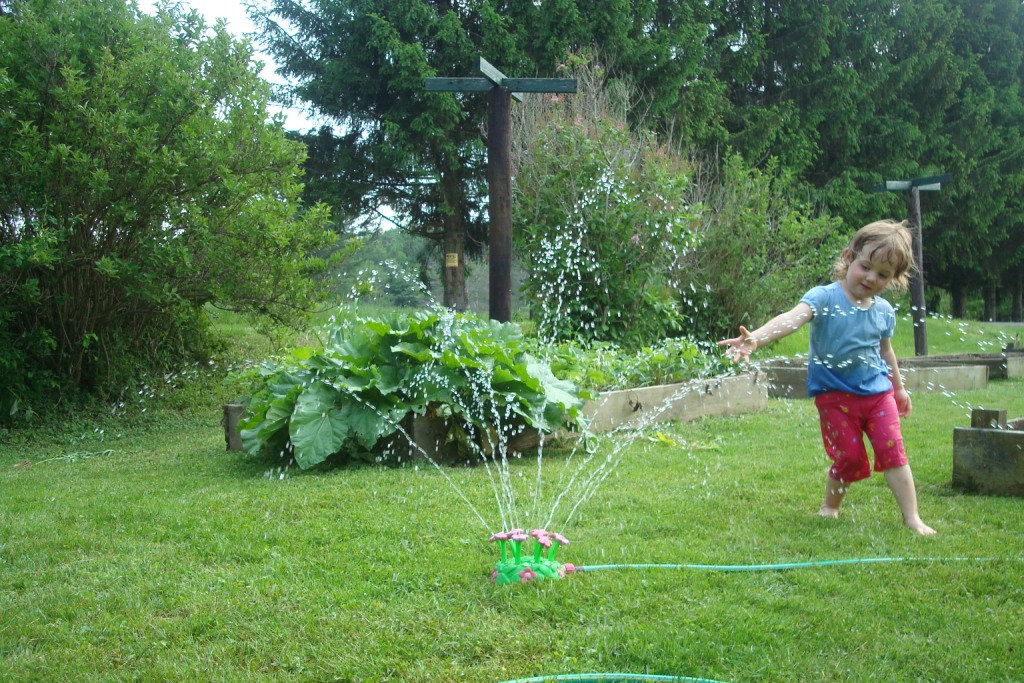
Pictured is another side of my two-year-old known as "I do myself!"
Friday, June 03, 2011
Seventeen Months Later
On 18 January 2010 we started the renovation of our bedroom. We planned out what we'd need, and roughly how much it would cost. And I thought to myself, "We've got this so well organized, it won't take more than three months to finish."
The proverb has been stated in various ways, "If you want to make God laugh, make plans."
The third-to-last item on the list was replacing the baseboard trim. Here's a sample of the process (which involved more sanding and re-urethaning than I'd hoped):


The proverb has been stated in various ways, "If you want to make God laugh, make plans."
The third-to-last item on the list was replacing the baseboard trim. Here's a sample of the process (which involved more sanding and re-urethaning than I'd hoped):


Then the closet doors needed to be urethaned to match the trim. Actually, "urethaning" is the wrong verb, because I used Minwax Polycrylic. I find, however, that in casual conversation, more people know what "urethaning" is than "polycrylicking."

The last bit? Replacing the door stop on the wall behind the bedroom door. I kept forgetting to stop at the hardware store to get a new doorstop, so this step dragged on for a month. When I got to the store and looked at the new stops, I discovered that I could actually use the old one again. Waiting for Godot.
 With Doorstop Godot on the wall, and all the trim finished, here's what our renovated bedroom looks like (standing-on-the-bed view):

And from next to the old closet door:


The last bit? Replacing the door stop on the wall behind the bedroom door. I kept forgetting to stop at the hardware store to get a new doorstop, so this step dragged on for a month. When I got to the store and looked at the new stops, I discovered that I could actually use the old one again. Waiting for Godot.
 With Doorstop Godot on the wall, and all the trim finished, here's what our renovated bedroom looks like (standing-on-the-bed view):
And from next to the old closet door:

Estimated price of the project before beginning: $690.
Actual cost of all supplies (not including untold labor): $838.10.
Actual cost as percentage of estimated cost: 121%.
Hm.
At least the cost projection was better than the completion date projection. It took almost six times as long as I thought.
But now . . . it is done!
~ emrys
Sunday, May 29, 2011




Jamestown: Life Complicated
Last week David and I rode to Jamestown, one of the other two historic sites near Williamsburg, Virginia. Before last week, if you had quizzed me on early American colonial history, I could have told you that Jamestown was one of the first three English settlements, founded in the early seventeenth century. It's come a long way since then, with motorized fountains, bronze sculptures, and flags from all fifty states at the entrance:
 After our tour from the National Park guide, I now remember that Jamestown was the first permanent English settlement in North America, founded by the Virginia Company in 1607.
 I remember learning that the first settlers encountered native Americans immediately upon their arrival. The character of those encounters depended both upon the history book one was reading and the person recounting the story. In elementary school we learned to make black paper Pilgrim hats and eat squash given by the native peoples on the first Thanksgiving. In middle school we learned that the threat of attack from the natives meant that every settlement had to have a palisade. This singular part of colonial history was full of ambiguity.
Less ambiguity now: I don't think any native American flags fly over the Jamestown monument.
 The first Jamestown settlers chose the location of their landing mostly to avoid the camps of natives and to hide from Spanish vessels in the Chesapeake. They imagined that the most significant obstruction to long-term life in North America would be Spanish competition (which had already founded a colony in St. Augustine, Florida). Boy, were they wrong.
 Agriculture jumps to mind as the primary economic engine for the first colonial settlements. But as we found out on our biking tour of the old Jamestown sites, glass-making also brought in some dough for the colonists. According to the placards at this site, English glassblowers could not satisfy the demand for glass in England at the turn of the 1600s. So there was a market for American glass.
 We walked around the excavated site of the former glass works, and looked on as craftsmen in period garb showed us how the art is done.
 I learned that glass is naturally green because of latent ferrous deposits in the silicate base. In order to make glass clear, one has to add other minerals.
 I imagine glass in the 1600s to be like plastic in the late twentieth century: cheaper and easier to make than its forebear, and lighter. We have plastic (better in some ways than metal or glass); the Jamestown settlers had glass (better than pottery).
 David and I had a fun National Park guide. I'm amazed at how much adults are like middle-schoolers. Give them a lecture, and they get fidgety and bored. Give them a class in which they might be called on to answer, complete with visual and tactile aids and role-playing, and they pay attention. Here's David, playing the part of a "savage," whom the colonists are asking for corn.
 Which brings me back to the original Jamestown settlement. They landed in the middle of a drought, but did not know it because they'd never lived here before. As the fresh water decreased, the brackish water from the river increased, and their wells became salty. Our guide told us that drinking brackish water too long "makes you stupid." As a result, when the settlers needed their wits the most, they were losing them.
 Leaders of the colony had been chosen by the Virginia Company, and the names of leaders were not revealed until after they landed--to prevent factions forming on the boat ride over. Thus leadership was not democratic, but appointed. The personalities of some of the leaders did not lend themselves to good relationships with either the natives or the settlers.
 The cultural divide between European and native widened when the English discovered that the native women did all the farming, gathering, and tending the home. The men went hunting and went to war. The former male activity especially was a luxury of the nobles in England; English men were expected to work, tend the fields, and build homes. Because of the delegation of tasks in English culture, native men received the stigma of being "lazy" from the get-go. When it came time to ask the natives for help, believing the other culture was inherently slothful could not have made the conversation easier.
 The Jamestown settlers' motives for coming to Virginia were not entirely economic. The group had an express intent to spread the faith of the Anglican church to new continents. The colonists had a zeal for the spread of the faith, even if it was more imperialist than the sort of zeal most Christian missionaries share today.
 Last week our power went out for forty-two hours. Not only did I discover how much of my life requires electricity, I gained a new appreciation for cultures and times that live without it. The matter of clean water, for instance, that I take for granted as long as we have a water purification system, the Jamestown settlers could not take for granted. Disease that now keep us in bed for a week (until the antibiotics do their job) could wipe out a whole town in 1607.
 I remember first learning about the colonists of Jamestown and Plymouth as if their success in America were a foregone conclusion. Since we're here today, there must have been a sort of manifest destiny at work--like SuperBowl champions saying they knew all along they'd win it. I have discovered this view is far from the truth. Not only did the colonists have drought, disease, relations with the natives, and poor leadership working pretty hard against them, they had the looming spectre of financial loss. The Virginia Company was a for-profit firm in London, the shareholders of which expected a return on their investment. If too many years passed without profit, the colonists would be called back home--whether the natives had become Christian or not.
[this photo needs explanation: it's a view of Jamestown ruins through a glass floor in the museum:]
 After our tour from the National Park guide, I now remember that Jamestown was the first permanent English settlement in North America, founded by the Virginia Company in 1607.
 I remember learning that the first settlers encountered native Americans immediately upon their arrival. The character of those encounters depended both upon the history book one was reading and the person recounting the story. In elementary school we learned to make black paper Pilgrim hats and eat squash given by the native peoples on the first Thanksgiving. In middle school we learned that the threat of attack from the natives meant that every settlement had to have a palisade. This singular part of colonial history was full of ambiguity.
Less ambiguity now: I don't think any native American flags fly over the Jamestown monument.
 The first Jamestown settlers chose the location of their landing mostly to avoid the camps of natives and to hide from Spanish vessels in the Chesapeake. They imagined that the most significant obstruction to long-term life in North America would be Spanish competition (which had already founded a colony in St. Augustine, Florida). Boy, were they wrong.
 Agriculture jumps to mind as the primary economic engine for the first colonial settlements. But as we found out on our biking tour of the old Jamestown sites, glass-making also brought in some dough for the colonists. According to the placards at this site, English glassblowers could not satisfy the demand for glass in England at the turn of the 1600s. So there was a market for American glass.
 We walked around the excavated site of the former glass works, and looked on as craftsmen in period garb showed us how the art is done.
 I learned that glass is naturally green because of latent ferrous deposits in the silicate base. In order to make glass clear, one has to add other minerals.
 I imagine glass in the 1600s to be like plastic in the late twentieth century: cheaper and easier to make than its forebear, and lighter. We have plastic (better in some ways than metal or glass); the Jamestown settlers had glass (better than pottery).
 David and I had a fun National Park guide. I'm amazed at how much adults are like middle-schoolers. Give them a lecture, and they get fidgety and bored. Give them a class in which they might be called on to answer, complete with visual and tactile aids and role-playing, and they pay attention. Here's David, playing the part of a "savage," whom the colonists are asking for corn.
 Which brings me back to the original Jamestown settlement. They landed in the middle of a drought, but did not know it because they'd never lived here before. As the fresh water decreased, the brackish water from the river increased, and their wells became salty. Our guide told us that drinking brackish water too long "makes you stupid." As a result, when the settlers needed their wits the most, they were losing them.
 Leaders of the colony had been chosen by the Virginia Company, and the names of leaders were not revealed until after they landed--to prevent factions forming on the boat ride over. Thus leadership was not democratic, but appointed. The personalities of some of the leaders did not lend themselves to good relationships with either the natives or the settlers.
 The cultural divide between European and native widened when the English discovered that the native women did all the farming, gathering, and tending the home. The men went hunting and went to war. The former male activity especially was a luxury of the nobles in England; English men were expected to work, tend the fields, and build homes. Because of the delegation of tasks in English culture, native men received the stigma of being "lazy" from the get-go. When it came time to ask the natives for help, believing the other culture was inherently slothful could not have made the conversation easier.
 The Jamestown settlers' motives for coming to Virginia were not entirely economic. The group had an express intent to spread the faith of the Anglican church to new continents. The colonists had a zeal for the spread of the faith, even if it was more imperialist than the sort of zeal most Christian missionaries share today.
 Last week our power went out for forty-two hours. Not only did I discover how much of my life requires electricity, I gained a new appreciation for cultures and times that live without it. The matter of clean water, for instance, that I take for granted as long as we have a water purification system, the Jamestown settlers could not take for granted. Disease that now keep us in bed for a week (until the antibiotics do their job) could wipe out a whole town in 1607.
 I remember first learning about the colonists of Jamestown and Plymouth as if their success in America were a foregone conclusion. Since we're here today, there must have been a sort of manifest destiny at work--like SuperBowl champions saying they knew all along they'd win it. I have discovered this view is far from the truth. Not only did the colonists have drought, disease, relations with the natives, and poor leadership working pretty hard against them, they had the looming spectre of financial loss. The Virginia Company was a for-profit firm in London, the shareholders of which expected a return on their investment. If too many years passed without profit, the colonists would be called back home--whether the natives had become Christian or not.
[this photo needs explanation: it's a view of Jamestown ruins through a glass floor in the museum:]
 During their second winter, the settlers lost two-thirds of their populace to starvation. The natives were hurting, too, because of the drought, but being natives they had the resources to tough it out. The Virginia Company settlers were in trouble. The next time a ship stopped by Jamestown, all the settlers got on board for London. The Jamestown settlement was over.
[here is a piece of slate, a permenant record of writing and drawings from Jamestown:]
 Over, that is, until they ran into the next supply ship sent by the Virginia Company, at the mouth of the James River. The Company had put a new commander in place, and he told the settlers to turn around and get back to work in the colony. With so many variables at work, after all it was one new head honcho and an extra supply ship that kicked the town into feasibility. And the next season the weather improved greatly.
 The following year a Virginian variety of tobacco was cultivated from smuggled stock, and the colony had her first cash crop. In the end, what made the colony viable in the long term was neither religious zeal, nor abundant health, nor perfect relations with the natives. The clincher was humanity's long-standing addiction to tobacco products, and the theft of a plant from the Caribbean.
 Contrary to the simplified lists of dates at the beginning of your textbooks, history is more complicated that multivariable calculus. One just never knows if or how a new venture will pan out. It might even become the beginning of a new empire. And if you dig deep enough in your history, you might find it much messier than you expected. Your victorious civilization might hinge on international thieves and cancer-causing addictions.
Life is complicated.
~ emrys
Subscribe to:
Posts (Atom)