Friday, October 12, 2012

Big Fat Lies?

Upon reading my lament about lowering my cholesterol and saturated fat intake, my brother sent me this link:


It is the first of a series of four videos which lay out an argument for why blaming heart disease on fat and cholesterol is wrong.

I'd love it if you would pursue an investigation of this argument with me, and let me know what you discover.

Shalom,
emrys

Monday, October 08, 2012

It's Time for a Change

I am no longer invincible.

This is my confession. Up until Friday, 5 October 2012, I have lived my life with bare audacious impunity. Like my fellow humans who live the same way, I have chosen a particular realm in which to express my impunity. That realm was fat.

Lipids. Long chemical chains with hydrophilic and hydrophobic regions which, when present in sufficient quantity in food, produce flavor.

Whenever possible, I chose cream over milk. I chose butter over margarine. Taking advantage of a metabolism that kept me rail-thin no matter what, I avoided low-fat products as if . . . they would kill me.

On Friday, the day of my pentannual checkup, my physician told me that my cholesterol and related numbers were up too high. Time to change my diet, he told me. Less cheese, less butter, less cream, less licking the spatula when making pie crust.

I am no longer invincible.

~ emrys

Sunday, September 23, 2012

Counting Your Name

When asked to introduce herself, my daughter has begun to announce herself in a "name, rank, serial number" fashion: "Gwendolyn Hope Tyler, Big Sister, Three and a Half" [years old].

Recently, as we made our way toward bedtime, I asked Gwendolyn to pick out three stories to read. She replied, "Three and a half?"

Assuming this meant we would have four books, I assented and she went off to her room.

When I got there, a tall stack of books--many more than four--stood on the bed.

"Gwendolyn! I said three and a half books."

Gwendolyn gave me a look as if I were a bumbling dolt. "No, let me show you." She began to take books off the pile, counting them as she spoke: "Gwendolyn. Hope. Ty. Ler. Big. Sis. Ter. Three. And. A. Half." Eleven books, one for each toddling syllable in her title.

I laughed with joy. And then we sat down to read--the top four books on the pile.

~ emrys

Sunday, September 16, 2012

My Father's Hand

Remember wide-ruled paper, with red lines for the margins? Remember putting a header with your name, the date, and the class on every sheet? It seems that this was the procedure as far back as 1948, when my dad took his 5th grade spelling tests:

This is yet another little find from the memorabilia I inherited from my dad. What strikes me more than the familiarity of the format and paper style is that of the handwriting. If we changed the names and dates to match my own 5th grade year, I could not now tell the difference between my dad's grammar-school penmanship and mine. By the time I knew him, Dad's handwriting was physician's scrawl; I've got my own peculiar version of chicken-scratch. But our young hands drew such familiar letters.

Is this a result of standardized training in penmanship (that did not change much between 1948 and 1986)? Or is much of handwriting in fact genetic?

~ emrys

Friday, September 07, 2012

Book Review: Transforming Evangelism

Transforming Evangelism, by David Gortner (2008), is one of the Episcopal Church's recent attempts to clarify and refashion the art of introducing others to Jesus Christ. The book covers a wide swath of theory about evangelism but does not neglect to go deep into practice. It offers not only well-thought-out grounds for how Christians offer the gospel of Jesus Christ, but also case studies and creative imaginings regarding how effective evangelism looks.

Like many books on evangelism in the North American Church today, Transforming Evangelism arises from a repugnant reaction to a widespread perception about evangelism. Many evangelistic efforts assert Christianity in terms that strike our culture as offensive. An extreme example of this trend is the annual group of believers who follow the Rose Parade in Pasadena with signs reading "Jesus or Hell" and "Repent: God Hates [choose your category]." As a result of this--and probably many less stark examples--a good proportion of both Christians and non-Christians believe that evangelism is, at its heart, an exercise in condemnation. Therefore regardless of what may come after it, the appearance of the word "evangelism" strikes fear into the hearts of people far and wide.

Another off-putting belief about evangelism, at least from the perspective of Christians, is that one does it out of duty. Jesus said to spread the good news, so I must do it out of obedience. Gone are the motivations of wonder and excitement of which we read in the New Testament. Instead has come a sense of obligation. One must pay taxes; one must go to the dentist; one must spread the good news. Transforming Evangelism seeks also to address this tendency in Christianity.

So, as the book's title intimates, evangelism must somehow be transformed into something that we Christians can do in good conscience. It seeks to re-establish the motivation for evangelism in gratitude to God for Christ's work in our lives. And it seeks to describe a way in which evangelism can be an offer to rather than and assertion upon the un-Christian. I found these goals proper and timely for the Church I know today.

Many of us who are disciples of Christ must examine our hearts to find what the Spirit is doing there on a regular basis. When we do, I believe, as this book asserts, that gratitude will become the proper and joyful foundation of every response we offer to God--from service to prayer to evangelism. Telling people they should believe in Jesus Christ solely out of duty seems hollow and pale compared to the powerful expansive witness that I see in the scriptures, and in a significant portion of my brothers and sisters of the faith. We do not invite people to cram themselves into a rigorous world of black and white; in Christ we find a celebration of God's explosive color. Transforming Evangelism brings this point out well.

In responding to the twin bugbears of evangelism, however, Transforming Evangelism threatens to toss the infant out with the slurry. The book attempts to redefine evangelism as something that is going on all the time in every person's life. (Here I might add that the book pulls up only short of a panentheistic view of the divine, which may lie behind the present problem.) To evangelize, then, is to get on board with what God is doing. This broad definition becomes so wide as to lose its point in the book. Witness the book's recitation of the story of St. Martin of Tours: Martin gave a beggar his cloak, then had a dream in which Christ affirmed his action. The book calls this an "evangelistic action" which transformed Martin himself. While the language of the scriptures would certainly affirm Martin's work as love, and would affirm Christ's appearance to him as theophany, it would not use the term "evangelism" for what happened.

The book also introduces the term "evangelistic listening." To listen to someone's story is to do evangelism. While listening is an essential skill of Christians, and preparation for an offer of the good news requires listening, "evangelistic listening" in the sense used here is uselessly oxymoronic. An essential part of the definition of "evangelism" is announcement, proclamation, telling (not just asking, listening, affirming). The good news of chicken on sale for $1.50 per pound is something one can proclaim to another. If I listen to your woes about only finding chicken for $2.30 per pound, and affirm your grief, and maybe offer to give you extra work so you can afford that expensive chicken, I may have served you well. But I have not offered you good news that will break into your chicken-buying world and introduce new possibilities.

We cannot shy away from the fact that evangelism is an introduction to a Person, and therefore has concrete, objective content. While true that some may not accept the invitation; while true that some--for their own reasons which ought not to trace back to our behavior--will be offended by Christ; while true that we will always be able to look back on a conversation and see ways we would rather have spoken; it is nonetheless true that evangelism is a proclamation of Jesus Christ. It is an announcement of his name, his lordship, and his role as savior. We may transform methods of evangelism. We may ask God to transform our hearts to do evangelism. But we may not transform this root of the good news without causing the vine to wither and die.

~ emrys

Monday, August 27, 2012

Oddities

I continue to take moments to sift through the next layer of records that came into possession at my dad's death. This week Gwendolyn and I shredded a whole file box of tax records. Dad kept every cancelled check that he wrote (he was still receiving cancelled checks in 2003, when many banks had stopped returning them).

In the shredding process my eyes lit on two things that made me stop and think.

Over the years 2001-2003, Dad's annual premium for malpractice insurance (he was a general surgeon) averaged $19,511. And Dad had never been sued, never been accused of any malpractice. The next time you wonder why physicians charge so much for their services, remember that their insurance premiums can exceed poverty-line salaries.

Since Dad owned his own practice and paid employees, he had to fill out taxes as a business owner. One of the tax forms for the City of Bethlehem (Pennsylvania) is titled "Occupational Privilege Tax." Privilege? Huh. I did not realize working was a privilege. Of course, I never have been pressed to place work in an ontological category. Necessity? Right? Privilege? Does this mean that one does not have the right to work in Bethlehem?

Do we have the right to work anywhere?

"Life, liberty, and pursuit of happiness." Is working an unalienable right?

~ emrys

Wednesday, August 22, 2012

Only Damnable Things


I was given cause recently to review the view of human will and sin described in John Calvin's Institutes of the Christian Religion (Library of Christian Classics version, 1967). In Chapter III of Book II (Knowledge of God the Redeemer), which chapter is titled "Only Damnable Things Come Forth from Man's Corrupt Nature," Calvin lays out an understanding of humanity and sin. It presages the Synod of Dort's declaration that humanity is "totally depraved." In reading this part of Calvin, I was struck by two things.

First, the uncompromising view of sin that Calvin takes and the conclusion to which that view brings him. Calvinism (distinct from Calvin's writings) has received much guff in the world for being pessimistic. This criticism is both accurate and incomplete. A proper view of sin taken from the Institutes will lead, indeed, to a rather dim view of humanity on its own. However, the Institutes does not ask us to consider humanity on its own, but as redeemed by Christ. In this redemption there is great hope. To attempt to access this hope without a dim view of human sin is a fool's errand (in this I agree with the Institutes), for the attempt will inevitably be too naive about the power of evil in the world.

Second, I notice how dependent on Augustine's writings is the Institutes. I had learned that Calvin drew on Augustine quite a bit. But the degree to which the Institutes uses Augustine's words as summary proof of its points surprised me. At first blush this seems to result from the family tree of Christian theology and philosophy in the European West: though Protestant, Calvin protested against a specific tradition, namely Western Roman Catholicism. He may have been bound by the Tradition of western Roman Catholic theology and therefore operated entirely from its premises--laid out by Augustine. I have not read the whole of the Institutes, but a scan of the abbreviations from the front of the book reveals a lack of reference to, for instance, the Gregories and Basils of Eastern theological tradition. Certainly the apophatic tendency of the East (say less about God, not more, lest you get it wrong) is defied by the 1600-page count of the Institutes.

This is perhaps the element most challenging to me in Calvin: the desire to explain in logically consistent detail every facet of one's belief. It challenges me both because I have a similar strong tendency in myself, and because I see from the scriptures that pursuing this desire may also be a fool's errand. Human persons, about whom we claim to have so much understanding, cannot be boiled down to a logical set of principles; how then shall we expect the deity to submit to the same?

~ emrys

Friday, August 10, 2012

Ganache Me

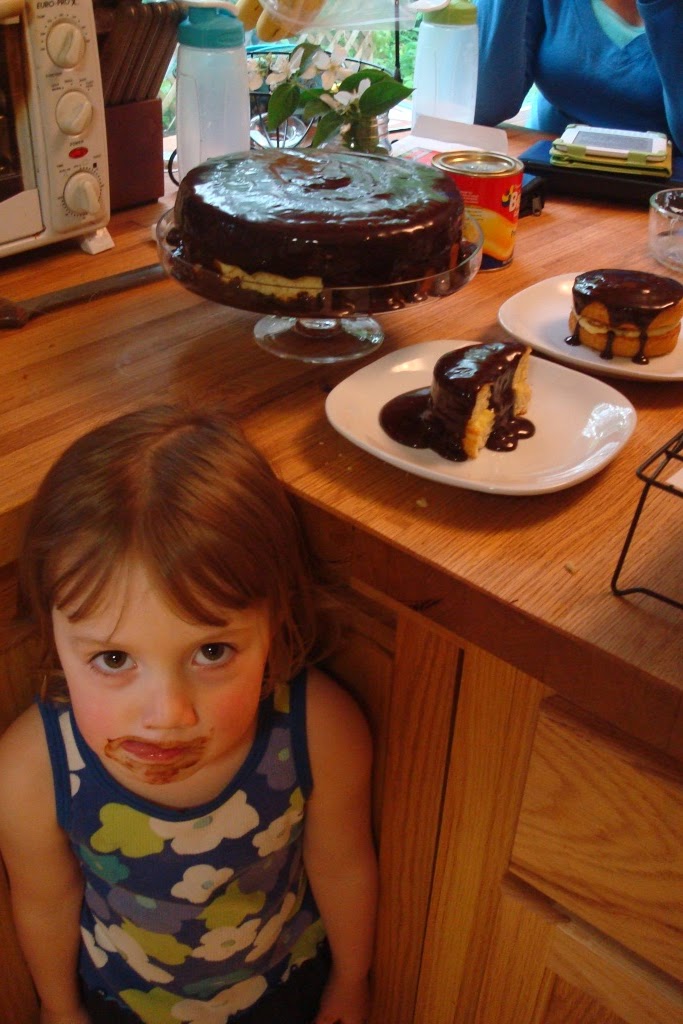
A few months ago I embarked on the experiment of making Boston Cream Pie. (It's not really a pie: It's a layer cake with filling and frosting.) I decided not to use the cheats (vanilla pudding, canned chocolate frosting) and make everything from scratch.

Rather than frost it in the traditional fashion, I elected to use a chocolate ganache. I find ganache is more fun to apply and to eat. And my little helper, there for every step of the not-pie-making process, had the same evaluation:

We only differ in where the ganache is applied.

~ emrys

Thursday, August 09, 2012

The New Guardians of Decency

We have arrived. The great innovation of American culture, arguably from the beginning according to some, is that the government will stay out of my way and let me pursue my own interest: "life, liberty, pursuit of happiness." Wherever you stand on the Demopublican spectrum, this is the ideal to which American government cleaves. The government will not criticize or incarcerate you because you choose to deal cards to people with gambling addictions; nor because you accumulate wealth while neighbors struggle to survive; nor especially because you say things to others that make your mother wish she could put you over her knee.

Freedom, especially of speech, is the linchpin of rights given to American citizens by their government.

But it is not guaranteed by employers.

Adam Smith, former CFO of Vante, discovered last week that although no officer of law enforcement would ticket him for his poorly-chosen words to Rachel at Chick-fil-A, his employer had no compunction about enforcing a certain ethic of conduct. To wit, from Vante's Marketwire statement: "We respect the right of our employees and all Americans to hold and express their personal opinions, however, we also expect our company officers to behave in a manner commensurate with their position and in a respectful fashion that conveys these values of civility with others."

Did you catch that? Smith has freedom of speech, but Vante--the one who holds Smith's paycheck--has an expectation that employees will limit that freedom according to a certain ethic. Even when they're not on the clock.

Most of us who are employed in the United States have something in the fine print of our contracts which declares that we may quit the job for any (and undisclosed) reason, and our employer may terminate our employment for any reason. We are hired at the will of our employers. Adam Smith discovered the limits of the will of his employer.

Adam Smith's case is a sign of a larger reality operating in America. Power to control and discipline social ethics parallels economic power. The government clearly does not insist that Smith be kind and respectful in his conduct toward drive-thru employees. I wonder if Smith's parents or teachers insisted on a high level of civility from Smith as he grew up. Smith's peers probably did not set high standards of grace and responsible expression.

But Vante will insist on good conduct, with force.

Let's be clear. My desire is not to complain about the situation, but to observe where we are. When our most dearly beloved cultural mantra is freedom, someone will have to set the limits on that freedom demanded by kindness. As words go viral on youtube, someone will have to determine where the buck stops. In our society, that responsibility will fall to those who have control of all the bucks: the ones who write our paychecks. Thus our fellow Adam Smiths will only learn that drive-thru employees shouldn't have to "listen to his frustration and disgust" when they've lost their paychecks for poor behavior.

~ emrys

Saturday, August 04, 2012

Why Projects Take Longer

with children.

In spite of the fact that our bathrooms are big enough to suit the Taj Mahal, we have always found it hard to place our laundry baskets in a convenient location. Behind the door? Then the door is always bouncing shut. Under the towel bar? Then they're in the way. Between the windows? Then you have to walk in an S-pattern to get to the sink. This five-year-old problem, however, was eased by the removal of the glass block quarter-walls around the toilet, because now we could bring up some cheap white cabinets that needed a new home, and get creative.

We decided to cut holes in the top of one cabinet which would house the laundry baskets (one for whites, one for colors). The baskets would be out of sight (and out of the way), but we just have to pitch our dirty clothes into the holes and they are sorted for laundering. Finally that middle-school compass came in handy for design work:

Some way into the project, I discovered that the final installation was complicated by a three-year-old who really wanted to "help"--that is, wanted to be involved. In the middle. Obstructive.
Even though she hadn't finished her lunch break yet (that's an apple whose juice she's smearing all over the project):
I had no idea that a cabinet with holes would be such a fun toy. (Why do we buy her plastic trinkets again?) It turns out that as much fun as I've had on the mallet end of Whack-A-Mole, Gwendolyn has on the hole end.
It's fun to hide and wait for Daddy to find you by looking down from above, then screaming like a little girl when he peeks over the edge:
No matter how much my work ethic butts up against three-year-old playfulness, I eventually discover every time that it's wiser to join in than try to win. So when my daughter insisted on trying to fit us both into the laundry playhouse, I went for it.
Yes. More fun than getting the project done on time.
 Much more fun.

~ emrys