We are on day three of no power thanks to the aftermath of Irene (thanks friends for letting me hijack power, internet outlets and your washer!) Here's a bit of last night's dinner conversation.
G: Mommy, lights broke!
Me: Yes Gwen, the lights are broke. (We'd gone through this one at least 4 dozen times since the power went out on Sunday.)
G: Mommy, potty broke!
Me: Yes, Gwen, the potty's broke because the power is still out so the water doesn't work. (She made this connection on Monday when much to her dismay, she couldn't flush the toilet.)
G: Mommy, water's broke!
Me: Yes, the water's broke until the power comes back on.
G: Mommy, HOUSE IS BROKE!
Me: Yup Gwen, the house is broke.
Then in all seriousness, she turns to Emrys:
"Daddy, fix it!"

Tuesday, August 30, 2011
Wednesday, August 24, 2011
Just Stand Still!
In the name of all that is sacred: stop "moving forward"!
Stop beginning letters, blogs, and press releases with "Moving forward." Stop diluting the perfectly good verb "will" with this trite participial phrase. Stop overstating our knowledge that we want most things in life not to go backward.
Just stop it.
~ emrys
Stop beginning letters, blogs, and press releases with "Moving forward." Stop diluting the perfectly good verb "will" with this trite participial phrase. Stop overstating our knowledge that we want most things in life not to go backward.
Just stop it.
~ emrys
Tuesday, August 23, 2011
From the Ground
I grew up in eastern Pennsylvania as it became a suburb of Philadelphia, then New York City. I high-tailed it to the urban grit of Montreal for university--and loved it. I took my first real job in a resort town in the Rockies--and miss it dearly. I went to seminary chewing the subtropical air of Los Angeles County.
How do I survive in the rural reaches of upstate New York, where the nearest cafe is twenty miles away?
I realized how just yesterday, as I rode my bike the ten miles home from soccer practice amidst fields of seven-foot corn stalks and August lushness:
in the country we see more clearly that life always springs up from the ground.
~ emrys
How do I survive in the rural reaches of upstate New York, where the nearest cafe is twenty miles away?
I realized how just yesterday, as I rode my bike the ten miles home from soccer practice amidst fields of seven-foot corn stalks and August lushness:
in the country we see more clearly that life always springs up from the ground.
~ emrys
Very Serious Work
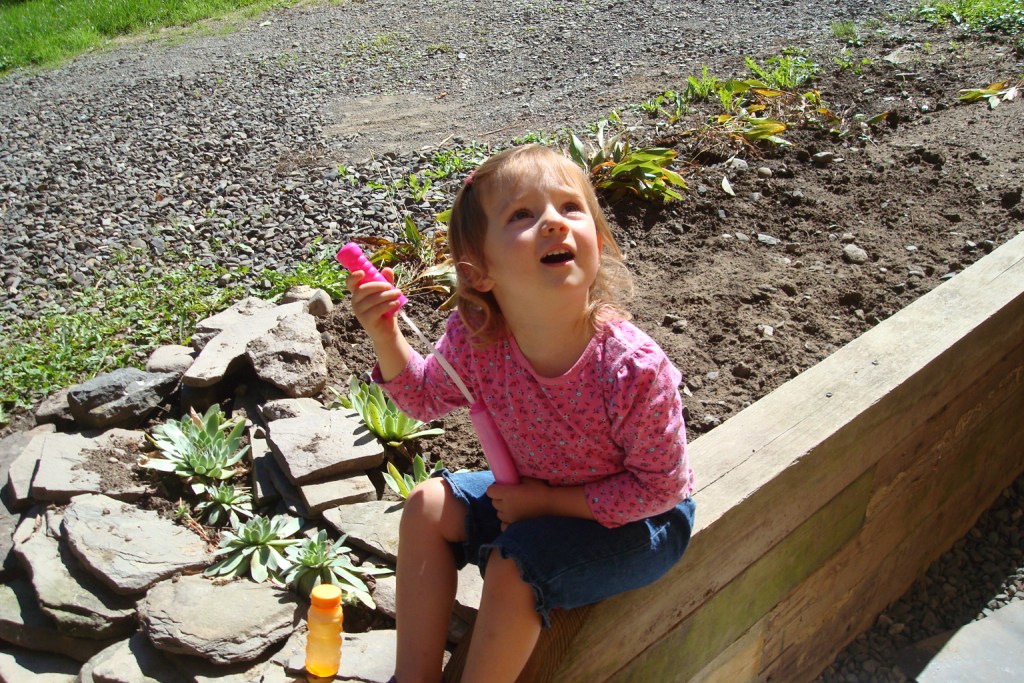
Bubbles are very serious work. First you have to fish the wand out of the bottle.

Then, you have to be able to blow through the wand just right...

Once you practice a little it will work:

And with practice and if you turn your head just right, you can blow big bubbles.

Finally you get to watch them float away!
Monday, August 22, 2011
Book Review: John Knox
In preparation for my Reformation Sunday sermon this year, I read a biography of John Knox (Rosalind K. Marshall, 2000). Before reading Marshall's book, my knowledge of John Knox was limited; I could only recite that he was one of the great reformers of the sixteenth century, a father of Scottish Presbyterianism.
I discovered about three-quarters of the way through the book that it is not quite accurate to attribute to Knox the flowering of Presbyterianism in Scotland. That accolade, according to Marshall, goes to Andrew Melville, who imported "fully-fledged Calvinism" to Scotland after Knox died, in the 1570s. However, Knox and his preaching were indeed powerful in combating Roman Catholicism in Scotland and giving Calvinist (or, maybe better, Swiss?) understanding of the Lord's Supper a foothold there--as opposed to the Lutheran understanding of the Lord's Supper.
Marshall convinced me that John Knox was a complex character who cannot be fairly reduced to this or that contribution to the history books. (This revelation, repeated over and over again in my life, is what keeps me studying history.) His motivations, obscure and muddled at best to those of us looking back, do not submit to simple categories or judgments. Like all of us, John Knox had the full complement of human complexity and changeability. If there was one thread that ran through his adult life, it was his dedication to simple obedience to the will of God revealed in the scriptures.
Even this thread, however, is dyed with different colors than we recognize today. I recently listened to a preacher declare (quoting someone else) that "Where goes the family, there goes the Church; where goes the Church, there goes the nation; where goes the nation, there goes the world." John Knox's world saw the structure of human society differently. Knox and his contemporaries, if I might dare to put words in their mouths, would have expressed it thus: "Where goes the King, there goes the kingdom; where goes the kingdom, there goes the Church; where goes the Church, there go the masses." Knox's age differed radically from ours in how the world worked, therefore how God worked, and therefore how the gospel should be preached.
Of his thirty-year career as preacher (at the end of which he died), Knox spent ten of those preaching directly against the female monarchs of Scotland and England ("Bloody" Mary I, and Mary Queen of Scots). He wrestled, in conversation and correspondence with the likes of John Calvin and Theodore Beza, with the question of what Christians ought to do if their monarchs disobey God. Knox formulated an interpretation of scripture by which Christians were allowed to rebel against kings and queens, an idea which was beginning to take hold in the philosophical corners of society but was still repugnant to most Church thinkers. The constant fear of those who heard Knox--both friends and enemies--was that giving authority to The People would mean descent into chaos.
Knox also lived and preached in a time when everyone was Christian. Or, perhaps more accurately, it would not occur to anyone (except Jews) in sixteenth-century Europe to declare faith in anything or anyone else than the Christian God. To be alive was to be Christian. Battles were fought and heretics were burned over differences in Christian faith; but atheism, Buddhism, genuine agnosticism, or others were never on the table.
On the other hand, as a parish pastor, some of Knox's work and tribulations sound stunningly familiar. While in Frankfurt, he endured great pains for a congregation in conflict over what form of worship service to use (Genevan book of prayer versus the English Book of Common Prayer). The fractures and debates have deep echoes with present-day debates over traditional versus contemporary forms of worship and music. After four hundred years, we have not come very far.
I will try to capture something of the spirit of Knox for my October sermon. To do this I think I will imagine what contemporary characteristic of the Church would inflame Knox the most. He behaved like a prophet, outraged at disobedience to scripture and "never fearing nor flattering any flesh." If transported in a time machine to 2011, to what reformation would John Knox call the Church? And then, what would he say? Time to find some of his sermons to read.
~ emrys
Sunday, August 14, 2011
Reading Material
A modification made by the online publisher Lulu has given me the excuse to remind you that we've got a couple of cool things in print (or downloadable in .pdf format). Check them out by clicking here.
~ emrys
~ emrys
Monday, August 01, 2011
The U2 Experience
On 20 July Sara and I went to the long-awaited fulfillment of my 2009 Christmas gift: the U2 360 concert at the Meadowlands. The show, billed to start at 7:00, opened at 7:45 with a mediocre heavy rock/metal band called "Interpol." Then the two-thirds-full arena entertained itself for half an hour while, we presume, the star act made itself ready. Finally, at 9:15, the Irish four took the stage to open with some of the classics from Achtung Baby.
Since the Zoo Station tour of the late '90s, U2 has combined good showmanship with technology and videography at their concerts. Perhaps emboldened by the fact that in an 80,000-person stadium the nosebleed seats can't see a lead singer, U2 has put cameras and oversized screens to good use. They amplify both sound and light to make a larger-than-life impact on the masses. The performance was as stunning as I'd hoped; what surprised and intrigued me was less the band and more the audience.
We used public transit to get to the stadium, which involved standing on the train platform for about an hour waiting for rerouted trains to get in order. As the platform filled up with fans ready for U2 action, I watched the restless throngs. I saw middle-aged couples with wedding bands; I saw college frat boys; I saw Baby Boomers who looked to be enjoying the first fruits of retirement, preppy high school kids, washed-up hippies, and dapper dressed professionals. I even saw a six-year-old girl with black ug-boots, tutu, jacket, and purple streaks in her blonde hair; she could have been a fast-forward version of my own daughter. The U2 age demographic would make most Church congregations jealous. Only skin color was uniform; my rough estimation, from observations made until the lights went down for the main event, is that the crowd was ninety-five percent white, two percent Asian, two percent Latino, and one percent (or less) African-American.
The repertoire for the concert revealed what I saw at the Pop Mart concert in 1998: as a whole, U2 fans connect more with the old classic songs than the new ones. The songs from the early '90s elicited more clapping, dancing, and singing along than those from the last four albums. When the band played I Still Haven't Found What I'm Looking For, all eighty thousand fans were on their feet, singing, clapping, and swaying. All around us were closed eyes, raised hands, and straining voices, anticipating every line and echoing every refrain. Under the night sky, immersed in the amplified beat and soaked in The Edge's aching string-work, I sang along with Bono, lifted my palms to the sky, and wept. Like the ancient clans brought to tears by Gaelic bards, I succumbed to the power of music. And it felt like . . . worship.
Now I know why folks follow bands like U2 across the country for entire tours. They want to feel part of something bigger than themselves. They want to feel larger than life, ecstatic with sound and light so bright they can only come from heaven. They want to be carried out of themselves, if only for a moment, and into something powerful and orchestrated and harmonious and . . . more than human. They want to worship. And the opportunity comes only once very four years at the cost of one hundred dollars a pop.
~ emrys
Since the Zoo Station tour of the late '90s, U2 has combined good showmanship with technology and videography at their concerts. Perhaps emboldened by the fact that in an 80,000-person stadium the nosebleed seats can't see a lead singer, U2 has put cameras and oversized screens to good use. They amplify both sound and light to make a larger-than-life impact on the masses. The performance was as stunning as I'd hoped; what surprised and intrigued me was less the band and more the audience.
We used public transit to get to the stadium, which involved standing on the train platform for about an hour waiting for rerouted trains to get in order. As the platform filled up with fans ready for U2 action, I watched the restless throngs. I saw middle-aged couples with wedding bands; I saw college frat boys; I saw Baby Boomers who looked to be enjoying the first fruits of retirement, preppy high school kids, washed-up hippies, and dapper dressed professionals. I even saw a six-year-old girl with black ug-boots, tutu, jacket, and purple streaks in her blonde hair; she could have been a fast-forward version of my own daughter. The U2 age demographic would make most Church congregations jealous. Only skin color was uniform; my rough estimation, from observations made until the lights went down for the main event, is that the crowd was ninety-five percent white, two percent Asian, two percent Latino, and one percent (or less) African-American.
The repertoire for the concert revealed what I saw at the Pop Mart concert in 1998: as a whole, U2 fans connect more with the old classic songs than the new ones. The songs from the early '90s elicited more clapping, dancing, and singing along than those from the last four albums. When the band played I Still Haven't Found What I'm Looking For, all eighty thousand fans were on their feet, singing, clapping, and swaying. All around us were closed eyes, raised hands, and straining voices, anticipating every line and echoing every refrain. Under the night sky, immersed in the amplified beat and soaked in The Edge's aching string-work, I sang along with Bono, lifted my palms to the sky, and wept. Like the ancient clans brought to tears by Gaelic bards, I succumbed to the power of music. And it felt like . . . worship.
Now I know why folks follow bands like U2 across the country for entire tours. They want to feel part of something bigger than themselves. They want to feel larger than life, ecstatic with sound and light so bright they can only come from heaven. They want to be carried out of themselves, if only for a moment, and into something powerful and orchestrated and harmonious and . . . more than human. They want to worship. And the opportunity comes only once very four years at the cost of one hundred dollars a pop.
~ emrys
Saturday, July 23, 2011
When I Grow Up
I want to be a Bank.
Banks get money loaned at 0% interest, and can then loan it out at any interest rate they choose (right now 3.5% at minimum).
That's as close as I've ever seen to free money.
I want to be a Bank.
~ emrys
Banks get money loaned at 0% interest, and can then loan it out at any interest rate they choose (right now 3.5% at minimum).
That's as close as I've ever seen to free money.
I want to be a Bank.
~ emrys
Sunday, July 17, 2011
Book Review: The Philippian Fragment
What do you get when you set the problems of twentieth-century ministry in the context of the first-century Church?
You get Calvin Miller's genius little read, The Philippian Fragment. With an insightful mix of contemporary congregational foibles, Latin and Greek erudition, and people getting thrown to the lions, Miller lifts up the heart of parish ministry. This series of letters recounts the trials and tribulations of Eusebius of Philippi as he writes of them to his confessor Clement. His (mis)adventures catalog some of the timeless conundrums of being a pastor: prerogatives of rich parishioners, competition with charismatic traveling evangelists, and whether Mother's Day has scriptural warrant.
I resonated with Miller's character Eusebius, laughed at the perfect Latin names, and found myself pricked by the implications for life in the Church from any age. What a fun read! Thanks to my friend Wes for passing it along to me.
~ emrys
You get Calvin Miller's genius little read, The Philippian Fragment. With an insightful mix of contemporary congregational foibles, Latin and Greek erudition, and people getting thrown to the lions, Miller lifts up the heart of parish ministry. This series of letters recounts the trials and tribulations of Eusebius of Philippi as he writes of them to his confessor Clement. His (mis)adventures catalog some of the timeless conundrums of being a pastor: prerogatives of rich parishioners, competition with charismatic traveling evangelists, and whether Mother's Day has scriptural warrant.
I resonated with Miller's character Eusebius, laughed at the perfect Latin names, and found myself pricked by the implications for life in the Church from any age. What a fun read! Thanks to my friend Wes for passing it along to me.
~ emrys
Thursday, July 14, 2011
Broken
(A meditation on the mystery of Genesis 32: 24-32.)
"Broken"
(emrys tyler 2011)
Out of the darkness and sliver of moon
Drifted a stranger, a wraith-man of doom;
He came without greeting
Night-wrestling strangler, he grabbed at my limbs
Muscles contorting, teeth gritted and grim
My strongest grip meeting
Till in the deadlock with twist and a bend
Out of the hip-joint my thigh did he rend
A strike for defeating
Whose hospitality shows up at night,
Welcomes a stranger by starting a fight?
Who leaves his name never spoken?
Clutching in spite of the star-spinning ache
I dreaded, terror-struck, that he would take
My breath in his pressing
Then his first words, “Let me go,” did he say
“Dawn-light comes quickly,” the warning he gave
My weakness addressing
Trick-fearing, wary I'd never survive,
Needing a sign that he'd leave me alive,
I asked him a blessing
Who offers mercy right after the fist,
Back-handed love, or a grace with a twist,
Good words in agony soaken?
“Jacob,” he told me, “your shadows grow long
With your close blood-kin a record of wrongs
Has made you notorious
“Israel is your new name for all time
Nations will tell of you in song and rhyme:
In struggle victorious!”
Dawning then came to my soul what I'd done:
Gone nose-to-nose with a heavenly one
An enemy glorious
Who was this messenger, able to bless
Me with a name to be wrung from duress?
Surely an angelic token?
Sunrise revealed him gone without a trace,
Save for the cripple that's twisted my face
And soured my song
Curious grandchildren point out my limp;
“God,” I then tell them, “has made me a gimp;
The story is long.”
After they’ve heard it, I make sure they know
Hobbling pride is the way our God shows
To whom we belong
What kind of visitor comes in the night?
What kind of angel hides from the light?
What kind of God leaves me broken?
~ emrys
"Broken"
(emrys tyler 2011)
Out of the darkness and sliver of moon
Drifted a stranger, a wraith-man of doom;
He came without greeting
Night-wrestling strangler, he grabbed at my limbs
Muscles contorting, teeth gritted and grim
My strongest grip meeting
Till in the deadlock with twist and a bend
Out of the hip-joint my thigh did he rend
A strike for defeating
Whose hospitality shows up at night,
Welcomes a stranger by starting a fight?
Who leaves his name never spoken?
Clutching in spite of the star-spinning ache
I dreaded, terror-struck, that he would take
My breath in his pressing
Then his first words, “Let me go,” did he say
“Dawn-light comes quickly,” the warning he gave
My weakness addressing
Trick-fearing, wary I'd never survive,
Needing a sign that he'd leave me alive,
I asked him a blessing
Who offers mercy right after the fist,
Back-handed love, or a grace with a twist,
Good words in agony soaken?
“Jacob,” he told me, “your shadows grow long
With your close blood-kin a record of wrongs
Has made you notorious
“Israel is your new name for all time
Nations will tell of you in song and rhyme:
In struggle victorious!”
Dawning then came to my soul what I'd done:
Gone nose-to-nose with a heavenly one
An enemy glorious
Who was this messenger, able to bless
Me with a name to be wrung from duress?
Surely an angelic token?
Sunrise revealed him gone without a trace,
Save for the cripple that's twisted my face
And soured my song
Curious grandchildren point out my limp;
“God,” I then tell them, “has made me a gimp;
The story is long.”
After they’ve heard it, I make sure they know
Hobbling pride is the way our God shows
To whom we belong
What kind of visitor comes in the night?
What kind of angel hides from the light?
What kind of God leaves me broken?
~ emrys
Subscribe to:
Posts (Atom)