During my chaplaincy internship I was paired with another woman from my seminary. The work of our internship included in-depth examination of how the stresses of chaplaincy revealed our strengths and weaknesses as pastors. These revelations came to us in many and varied ways, but usually within interactions with other people.
At one particularly stressful point in our work together, she and I gave each other nicknames which allowed us not-so-passively to express our consternation with the circumstances. The nicknames stuck long after our internship ended. Since that week, I have called her Freak Show. And she has called me Monkey Butt.
Imagine my glee when, a few months ago, I came across this product in the hardware store:
Here's to you, Freak Show!
~ emrys
Sunday, May 26, 2013
Saturday, May 04, 2013
Creative Learning
We purchase an annual membership to a national association of children's museums and science museums. Ever since we encountered the Discovery Center in Binghamton with a toddling Gwendolyn, we have discovered great joy in spending quality time in these paragons of civic effort. During this week's vacation in Durango, Colorado (our home away from home), we found that our membership pass gets us into the newly established Durango Discovery Museum.
Discovery Centers, Science Centers, and Discovery Museums have the twin goals of hands-on education and fun for kids of all ages. I do mean all ages; here is Jill climbing up a stylized tree house, finding her inner contortionist:
As part of a promo weekend, the Discovery Museum had a set of Imagination Playground blocks--imagine Kinex magnified and fashioned from blue foam--of which Gwendolyn availed herself for about an hour.
She systematically collected blocks from the scatter created by other kids' work; I did, on occasion, need to remind her that cannibalizing blocks from other children's projects-in-process was not allowed. She was quite determined to include every possible block in her architectural wonder. She required little help except to learn how twisting a foam noodle helps to thread it into another block.
I took great joy in watching her creative vision play out on the sunlit patio. I also took great sobriety in watching the young children interact and noting that without parental intervention our offspring would have played out a version of Lord of the Flies. There was lots of enforced sharing and rebukes for stealing blocks. But aside from one meltdown among a group of twelve or thirteen kids, the afternoon's activities went off without serious incident. And a foam city brought concrete expression to the heart of my four-year-old daughter.
If you ever have the opportunity to engage the joy and learning of a children's museum . . . engage!
~ emrys
Thursday, April 18, 2013
New (Wow!) Horizons
I understand naming stadia after the fan-attracting teams that play in them (for instance Giants Stadium in the northeast). I understand naming stadia after the companies that funded their construction (Staples Center, for instance). I do not yet understand what I saw in Louisville, Kentucky this week. Here is a photo of a stadium's name above a digital rolling advertisement screen positioned in view of both ticket-buying fans and Main Street Louisville:
The name is also stamped in story-tall letters facing the bridge across the Ohio River, on the opposite side of the building.It's not Cardinal Stadium, though the name of that mascot figures prominently--that's the red C in the right of the photo. It's not simply the KFC Center. It appears to be the KFC (Yum!) [I don't even know how to represent it properly in text] Center.
I'm not quite sure what to do with the onomatopoetic ejaculation when verbally naming this facility. Is the (Yum!) there for purely visual appeal, so the uttered name is "KFC Center"? Or is the bubble pronounced, as in "KFC Yum! Center"? And if it's pronounced, does one indicate the exclamation point with inflection and pause ("We're going to the KFC Yum! . . . Center, kids!") or does one say the three words in one smooth phrase ("There's a long line at the KFC Yum Center today")?
I should have asked someone from Loouhvul while I had the chance. (Sigh!)
~ emrys
Monday, April 08, 2013
Enduring Value
Last week I finished my first reading of The Odyssey by Homer. Alas, I do not read classical Greek, so I had to settle for reading this ancient epic poem in translation. I chose Robert Fagles' work (1996).
The book had occupied my shelf for several years. I glanced at it occasionally, both drawn to its epic reputation and terrorized by its thickness. I vaguely recall that I had to read excerpts of the poem in high school English class. I feared that one third of the way through the Homeric opus I would feel the same as I had about so many other English assignments: that getting to the end would be a chore.
I was pleasantly surprised. To be clear, Fagles' translation is loose. He does not hold to the dactylic hexameter of Homer's work. He does not try to "translate" the poetry in conformity to modern convention with, say, rhyming lines. He does not attempt to bind his translation to a rubric which results in an overwrought product. Like Odysseus our hero, Fagles' work is clever, intriguing and manipulative, drawing the reader sympathetically into his own narrative.
The book was a page-turner for me. Though I often do my leisure reading late at night before sleep, I was always at pains to put this volume down. The character of Odysseus, the twists and turns of his fate, the vicissitudes and irrationality of the gods, and the tension of Penelope's resolve all held me rapt for the next reading. In short, all the reasons why Homer's work has survived the test of time rang true in my heart as I read it. The narrative so enthralled me that I felt cheated by the ending--as many do, I found out later--which seems much too abrupt given the scope of Odysseus' adventures and personality.
Not for its reputation, but for those enduring foundations on which the reputation is based--journey, hospitality, nobility of heart, fate, justice, perseverance, hope, and the destiny of coming home--get yourself a copy of Homer's Odyssey and read it. Again, if necessary.
~ emrys
Sticky Fingers
More than a year ago we received The Toddler Cookbook as a gift. It's a cookbook with simplified recipes that parents can do with their pre-schoolers. The directions for each recipe are written as if addressing someone who's not qualified to handle a kitchen torch (lots of "Ask an adult to . . ." and "Wash your hands" after every handling of raw meat). But the book also assumes that toddlers can use a cup to measure sugar and stir ingredients together (which, of course, they're quite able to do, even if a little more wobbly so at times).
Annabel Karmel is the author; she seems to specialize in parent/child books, as our two baby record books are both authored by her. One thing that I found impressive about this book was the representation of different people groups in the illustrating photos. Boys and girls, men and women, whites and blacks are making these recipes. As someone who lives in a solid white-bread band of country with old-school values, I appreciate opportunities, no matter how passive, for our children to observe that there are many folk who look different than we do. And I appreciate cookbooks that do not assume all cooking and baking will be done by those with double-X chromosomes.
Gwendolyn and my first adventure with Ms. Karmel was the recipe for "chicken dippers": fried chicken strips with different dipping sauces. Here are my daughter's fingers dousing the chicken before breading:
We run a high-end kitchen in our home. We ask even the sous-chefs to come dressed in formal silk dresses and gold angel wings (though shoes are optional):
I am discovering that the vast majority of recipes are in fact toddler/pre-schooler-friendly, with a little adult help. Karmel's book is little more than an illustrated cooking guide with fun fonts and encouragements. But I must admit that sometimes a book with a couple of gimmicks is necessary to open up new possibilities for me.
The Toddler Cookbook by Annabel Karmel (2008): a reminder of how wonderful it is to have multiple generations in the kitchen, and another reason to love DK books.
~ emrys
Annabel Karmel is the author; she seems to specialize in parent/child books, as our two baby record books are both authored by her. One thing that I found impressive about this book was the representation of different people groups in the illustrating photos. Boys and girls, men and women, whites and blacks are making these recipes. As someone who lives in a solid white-bread band of country with old-school values, I appreciate opportunities, no matter how passive, for our children to observe that there are many folk who look different than we do. And I appreciate cookbooks that do not assume all cooking and baking will be done by those with double-X chromosomes.
Gwendolyn and my first adventure with Ms. Karmel was the recipe for "chicken dippers": fried chicken strips with different dipping sauces. Here are my daughter's fingers dousing the chicken before breading:
We run a high-end kitchen in our home. We ask even the sous-chefs to come dressed in formal silk dresses and gold angel wings (though shoes are optional):
The meal was delightful. We finished off every bit of those chicken dippers:
Gwendolyn and I had so much fun that for my birthday supper I requested we do another recipe from the book. In fact, we did two: chicken satay skewers, and peanut butter bears (no-bake cookies with rice puffs as the base, pictured here):I am discovering that the vast majority of recipes are in fact toddler/pre-schooler-friendly, with a little adult help. Karmel's book is little more than an illustrated cooking guide with fun fonts and encouragements. But I must admit that sometimes a book with a couple of gimmicks is necessary to open up new possibilities for me.
The Toddler Cookbook by Annabel Karmel (2008): a reminder of how wonderful it is to have multiple generations in the kitchen, and another reason to love DK books.
~ emrys
Saturday, March 02, 2013
Hidden Worldviews
I continue to be fascinated by the gifts that come to me from the members of my flock. These presents often reveal--as perhaps all gifts do--as much about the giver's perception as about the desires of the receiver. I receive gifts that seem like they came from the "Gifts for Your Pastor" shelf at the local Christian store; there are those that fall into the "I liked this, so I'm sure you must, too," category; there are those that clearly answer my expressed preference; and there are those that serve as catch-all (like money).
I get a good number of books from members of the congregation. The books fall into the first three of the above categories, probably in equal measure. Occasionally, however, one will start in the "I liked this . . ." category and, upon my reading of it, will move into the "right up my alley" category. Hidden Worldviews by Steve Wilkens and Mark Sanford (2009) turned out to be such a book.
Hidden Worldviews: Eight Cultural Stories That Shape Our Lives observes eight ways that twenty-first century Americans view their world and critically evaluates how those views line up with Christianity.
One of my last courses in seminary was a teaching on worldview, and it opened up my eyes to the power and richness of worldview over against simple points of faith doctrine. My introduction to worldviews gave me a holistic way to view faith and life. Typical of my generation, I was interested in the complete web of connection between personal narrative, metanarrative, ethics, and faith doctrine. I prefer to deal with the big picture rather than any of these in isolation. Wilkens and Sanford step back to look at the big picture of how we make meaning of and live in the world.
Hidden Worldview strikes a beautiful balance. It thoroughly evaluates each of the eight worldviews (for instance: individualism, scientific naturalism, and salvation by therapy), noting both positive and negative features. It refrains from pedantic lecturing, maintaining a graceful voice throughout. It speaks with both gravity and levity in due season. Its conclusion encourages the reader to develop a Christian worldview, naming particular helpful considerations. And it does all these things in 218 pages.
Here is a thorough, useful, and accessible introduction to the possibilities and problems of worldview. Unlike so many books that find their way under my nose, this one won't be given away quickly. Loaned, perhaps, but not surrendered.
Thanks to Steve for this good gift!
~ emrys
Friday, March 01, 2013
Pajama Party!
Two weeks ago, on my day off, the kids and I were bumming around the house. When the mail came, Gwendolyn received a gift of yellow M&M pajamas from my mom. She donned them immediately and declared that today was a Pajama Party day.
She also decided that winter hats were necessary as part of our pj ensembles. So Micah and I obliged and suited up.
The hats took a little explaining when Mommy got home.
~ emrys
She also decided that winter hats were necessary as part of our pj ensembles. So Micah and I obliged and suited up.
The hats took a little explaining when Mommy got home.
~ emrys
The New Room
In an earlier post I wrote of the treasure hunt I set up for Gwendolyn on Christmas. Here is the promised post about the gift at the end of the trail.
Way back in 2008 I painted the room which would, for the first three years of her life, belong to Gwendolyn. The arrival of our second child made us decide to convert the other half of that room (it's really a single room divided in two by a partition) into a new bedroom for Gwendolyn and hand down the orange-and-green room to Micah.
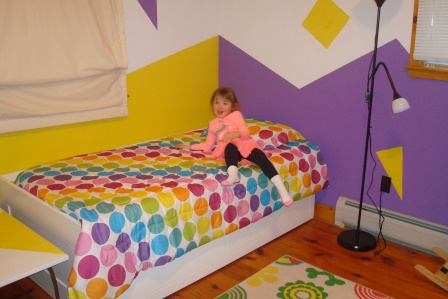
Seeing this change as an opportunity for artistic expression, I decided on a scheme for painting the walls in Gwendolyn's New Room. Rather than the circles and curves of the nursery, I preferred lines and polygons this time. For some reason which still mystifies me, Sara agreed to my proposal for bright yellow and purple.
After some brief work with ruler, pencil, and square, the painting began:
Because the project was a surprise, and because Gwendolyn's schedule and mine rarely lined up during the day, most of the painting was done at night, after she had gone to bed. I had to sneak through her room to get to the New Room. Because it was winter, the windows had to stay shut. Which means I'm in for it when they discover, twenty years from now, all the horrible effects of inhaling the off-gases from vinyl paint.Below you can see that the former coffee table is getting its second life:
Et voila! The finished New Room, with new bed and linens bought for the occasion. (Note that the purple and yellow on the walls match the same colors on the comforter:)
Plus Gwendolyn gets Sara's heirloom dresser and mirror:
I had to keep the New Room locked until Christmas day, even though Gwendolyn knew that something for her was going on behind the door. I suspect that even before she started her Christmas morning treasure hunt she knew where it ended. Here she is discovering one of the clues in her hunt (note the pink outfit given to her by her Best Friend Kerri):She was so excited that she almost literally bounced off the walls. This process was aided by the fact that her first move was to test out the spring in her new mattress:
As an added bonus, the placement of her bed affords her a view over the driveway and front of the house. When she's old enough, she'll discover that it's safe to climb out her window onto the front roof, from which she can jump to the ground without hurting herself. (I discovered this about our bathroom window at my dad's house in high school.) Here's hoping she'll never need to use it that way.
All of January, whenever someone came to visit the house, Gwendolyn would exclaim, "Let me show you my New Room!" That made all the vinyl paint fumes I huffed worth it.
I just hope she doesn't expect a New Room every Christmas now.
~ emrys
Making Memory
One month ago we started offering Cheerios to Micah. With eight incisors and a propensity to gnaw, he can crack the toasted Os or he can gum them over his budding molars. I say that we "offer" him Cheerios, rather than "feed" them to him, because part of his learning process is trying to pick them up from the high-chair tray.
Micah doesn't quite have down the coordination of his thumb and forefinger. When he goes for a toasty cereal bit, he usually pinches his quarry between the tip of his forefinger, the base of this thumb, and the tray surface. The porous cereal chunks stick to his skin, even if he doesn't have the best grip. With that sideways hold he can get it up to his face. At this point, however, a quandary arises: Since the Cheerio is not at the most accessible point on his hand (out between tip of thumb and tip of forefinger), how will he get it into his mouth?
The day is saved by the fact that Micah does not yet have any compunction about stuffing his whole hand into his mouth, even if it's an inefficient way to get that crumbly ring of oats.
The most fascinating part of this learning curve, to me, takes place away from the table. When I'm holding Micah--talking to him, babbling with him, walking him around the house--I see that his thumb and forefinger are quietly rehearsing their routine. Micah's eyes and attention may be on something on the other side of the room; but his forefinger and thumb are softly pinching and releasing, pinching and releasing. It's as if he's watched us show him how to pick up a toasty O, and now while they're not doing anything else, his digits are using the down time to master their moves. I imagine that they're forming the neuromuscular pathways that are second nature to us adults, who can pick nuts out of a bowl without looking a second time. Micah's on his way.
Always learning, always growing. I love it.
Friday, February 08, 2013
A Thought on the Church
A fair bit of observation, a good chunk of listening, and a lot of thought birthed this little piece. If you have responses, I'd be glad to hear them.
~ emrys
Subscribe to:
Posts (Atom)